
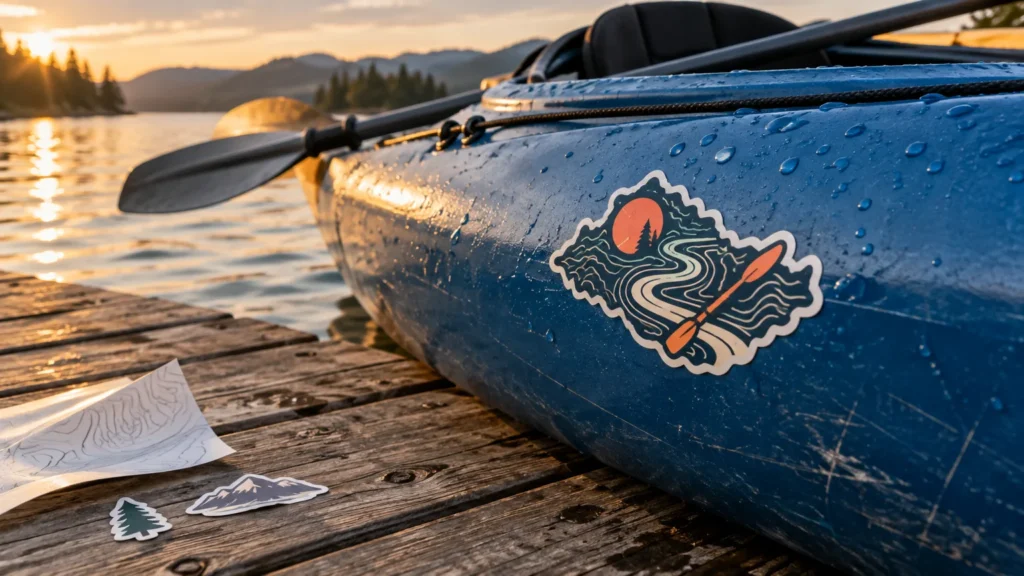
TLDR: Choose laminated vinyl for custom kayak stickers, but do not treat “waterproof” as proof that the adhesive will bond to your hull. Smooth composite and thermoformed surfaces are generally easier sticker candidates than textured polyethylene. For a rotomolded kayak, ask the printer specifically whether its adhesive is intended for HDPE or other low-surface-energy plastics. Use a compact shape with rounded corners and place it above the waterline, away from scraping, paddle contact and heavily curved areas.
The central issue with custom kayak stickers waterproof enough for real use is not simply whether rain or spray can damage the print. A kayak decal also faces sunlight, wet storage, transport straps, sand, repeated handling and edge impacts. Even an excellent laminated print can peel if its adhesive does not like the hull material.
That makes the kayak itself the first part of the buying decision. Identify the hull material, inspect the texture and choose a relatively protected placement before ordering. Then match the vinyl, laminate, adhesive and sticker shape to those conditions.
Are custom vinyl kayak stickers waterproof?
A properly constructed vinyl sticker with a protective laminate is a sensible baseline for a kayak. The vinyl provides the printable face stock, while the laminate protects the printed surface from water contact, sunlight and routine rubbing. CustomStickers.com currently describes its waterproof stickers as vinyl with a UV-resistant laminate and offers matte and gloss finishes. YouStickers describes a similar vinyl-and-UV-laminate construction for its waterproof sticker product.
That construction addresses the printed face, but four separate things determine whether a kayak sticker lasts:
- Print and laminate durability: whether the image resists water, fading and surface wear.
- Adhesive compatibility: whether the adhesive can form a dependable bond with the hull material.
- Edge security: whether corners and narrow design features begin lifting after rubbing or repeated water exposure.
- Placement: whether the decal is protected or repeatedly dragged over racks, straps, docks, sand and shorelines.
This is why a waterproof sticker can still peel. The ink and laminate may remain intact while the adhesive releases from the kayak or an exposed edge catches on something.
Polyethylene is the difficult part of the job
Many rotomolded kayaks are made from polyethylene. For example, Perception states that its rotomolded kayaks use high-density linear polyethylene. Check your own manufacturer’s specifications rather than assuming every kayak uses the same material; composite, thermoformed, painted and inflatable boats present different bonding surfaces.
Polyethylene and polypropylene are low-surface-energy plastics. In its guide to categorizing surface energy, 3M identifies both materials as low surface energy and explains that materials below 36 dynes per centimeter are difficult to bond. In practical terms, an ordinary pressure-sensitive adhesive may have trouble spreading out and establishing intimate contact with the plastic.
Texture compounds the problem. A pebbled rotomolded hull gives the adhesive less continuous contact than a smooth panel. Strong finger pressure cannot make a flat sticker conform perfectly into every recess. A product can therefore be accurately marketed as waterproof and still be a poor match for textured HDPE.
Before placing a large order, ask the vendor a precise question: “Is the adhesive recommended for permanent outdoor application to textured rotomolded HDPE?” Do not settle for an answer that only repeats that the sticker is waterproof or outdoor rated. If the vendor cannot confirm compatibility, order a sample or the smallest practical quantity and test it in the intended location.
Choosing waterproof custom kayak stickers
| Feature | What to choose | Why it matters on a kayak |
|---|---|---|
| Face stock | Outdoor vinyl rather than uncoated paper | Vinyl is the practical base for repeated water contact and outdoor handling. |
| Protective layer | UV-resistant laminate | The laminate protects the printed surface from sunlight, spray and rubbing. |
| Adhesive | One explicitly compatible with the hull material | Water resistance does not solve poor adhesion to polyethylene or a textured surface. |
| Shape | Compact silhouette with rounded transitions | Fewer points, thin extensions and sharp corners means fewer vulnerable edges. |
| Finish | Gloss or matte laminate | Both can work; choose by appearance and visibility rather than assuming one fixes adhesion. |
| Format | Individual die cuts for isolated graphics; transfer decals for separate lettering | The right format makes positioning easier and reduces unwanted background material. |
If the vendor can confirm the appropriate adhesive, laminated waterproof stickers from a custom sticker printer are a reasonable format for names, club graphics, trip badges and decorative artwork. The adhesive confirmation matters more than choosing a familiar brand or the strongest-sounding durability label.
Matte versus gloss
Gloss laminate makes color and contrast look punchier and often matches the visual character of a shiny or brightly colored hull. Matte reduces reflections and can suit subdued graphics, fishing kayaks and equipment with a low-sheen surface. Both finishes can protect a printed sticker when the underlying construction is appropriate.
Finish does not correct an adhesive mismatch. Choose matte or gloss for appearance and readability, then evaluate adhesion separately. Directional reflections can also affect small lettering, so a matte finish may be easier to read from some angles even when gloss produces richer-looking color.
Die-cut shape and artwork
A kayak is not a gentle display surface. Designs with thin fishing rods, narrow script flourishes, pointed fins or isolated specks create small areas that can lift or tear. Simplify the outer contour and connect fragile details to the main shape. Rounded corners and broad bridges between design elements are safer than sharp points.
Give small text enough size and contrast to remain readable from the expected viewing distance. If the hull is dark, make sure the design has opaque light areas where needed; do not assume clear material will make pale colors visible. Ask whether the printer uses white ink or a white underprint when ordering clear stickers.
Where to place a kayak decal
Favor a smooth, relatively flat area above the normal waterline. Good decorative placements are often on the upper side of the hull, deck or another section that is visible but does not take the full force of launching and landing. Inspect the exact location while the kayak is on its rack and while you hold the paddle normally.
Avoid areas that regularly contact:
- roof-rack pads, tie-down straps or storage cradles;
- the paddle shaft or blade during normal strokes;
- docks, sand, gravel or the ground when the kayak is moved;
- deep molded texture, drainage channels and abrupt ridges;
- tight compound curves that force the sticker to wrinkle or bridge;
- panel edges, hardware and recesses where water and grit can work against the decal edge.
Placement changes durability more than many buyers expect. A premium decal on the bottom of a hull can be scraped quickly, while a modest sticker on a smooth, protected upper section may remain presentable much longer.
Saltwater, sunlight and abrasion need separate attention
Marine use is harder on graphics than ordinary outdoor display. Avery Dennison’s bulletin for marine applications of its wrapping film discusses reduced durability relative to vehicle applications as well as saltwater, cleaning, exposure and edge sealing. That bulletin concerns a specific wrapping-film system rather than small printed kayak stickers, but the practical lesson carries over: marine exposure involves more than occasional rain.
Kayak care matters too. Perception’s owner manual advises rinsing the kayak after saltwater use and identifies UV exposure and abrasion as maintenance considerations. Rinsing salt and grit from the decal area can reduce material left to grind against the printed surface and edges. Use the kayak maker’s cleaning guidance and avoid aggressive scrubbing across the sticker edge.
Do not order based on a claimed outdoor lifespan alone. A vendor’s outdoor-life figure may describe the sticker construction under general outdoor conditions, not adhesion to textured polyethylene, repeated beach landings or contact with transport straps. Ask about the actual substrate and exposure.
A cautious application process
Use the sticker and kayak manufacturers’ instructions where available. The goal is a clean, dry surface and complete adhesive contact without introducing cleaners or treatments that leave residue or damage the hull.
- Confirm the hull material with the kayak manufacturer or product documentation.
- Choose the flattest, smoothest and most protected suitable location.
- Wash away dirt, salt, wax and loose contamination using a hull-safe method, then let the area dry fully.
- Position the sticker before removing the liner. Use a temporary alignment reference if the graphic must be level.
- Apply from one side toward the other, pressing the adhesive into the surface rather than dropping the whole sticker at once.
- Press across the center and work toward the perimeter, paying particular attention to the edges.
- Follow the sticker vendor’s stated temperature and dwell-time guidance before launching or washing the kayak.
- Inspect the edges after the first few outings. Replace a lifting decal before trapped grit expands the failure.
Do not improvise with flame treatment, strong solvents, primers or edge sealers unless the relevant kayak, adhesive and treatment manufacturers approve the combination. Those methods are product- and material-specific. A small test sticker is the safer starting point when compatibility is uncertain.
Decorative decals are not automatically registration markings
A custom kayak sticker can display a name, logo or decorative design, but legal registration markings are a separate task. Requirements can vary by jurisdiction and may specify character size, spacing, contrast, location or validation decals. Check the current rules from the authority responsible for registering your boat before ordering.
Keep decoration from interfering with required numbers or official decals. If you need custom-cut registration characters, provide the vendor with the exact required dimensions and spacing rather than resizing them by eye. Transfer-style lettering can make separate characters easier to align, but the adhesive still needs to suit the hull.
Questions to ask before ordering
- Is the adhesive recommended for HDPE, polyethylene or the exact material used by my kayak?
- Will it work on a textured rotomolded surface, or does it require a smooth substrate?
- Is the printed face protected by a UV-resistant laminate?
- Is the construction intended for repeated freshwater or saltwater exposure?
- What application temperature and dwell time does the manufacturer specify?
- Does the vendor recommend a test sample, approved primer or edge treatment for this surface?
- Can the artwork be simplified to remove narrow points and fragile cut sections?
- Are the matte and gloss versions built with the same adhesive?
If you are comparing waterproof constructions for other frequently washed gear, our guide to choosing water bottle stickers explains how surface shape, edge placement and cleaning routines change the decision.
The practical recommendation
Start with a laminated outdoor vinyl sticker, a compact die-cut shape and a protected above-waterline location. If the kayak is polyethylene—especially textured rotomolded HDPE—do not place a large order until the printer confirms adhesive compatibility or you have tested a sample on the intended surface.
The best kayak sticker is not merely the one with the toughest waterproof claim. It is the construction whose laminate protects the artwork, whose adhesive suits the hull, and whose placement keeps vulnerable edges away from abrasion. Get those three decisions right before choosing between matte and gloss or refining the artwork.
References
- Waterproof Stickers | Durable Custom Stickers – CustomStickers.com
- Waterproof Stickers | YouStickers | Durable, Waterproof Vinyl
- Owner’s Manual
- Categorizing Surface Energy | 3M Science of Adhesion Educational Series
- TB 3.14: Application Instructions for Avery Dennison® Supreme Wrapping Film in Marine Application with Avery Dennison Edge Sealer