
TLDR: Choose laminated permanent vinyl for most outdoor stickers
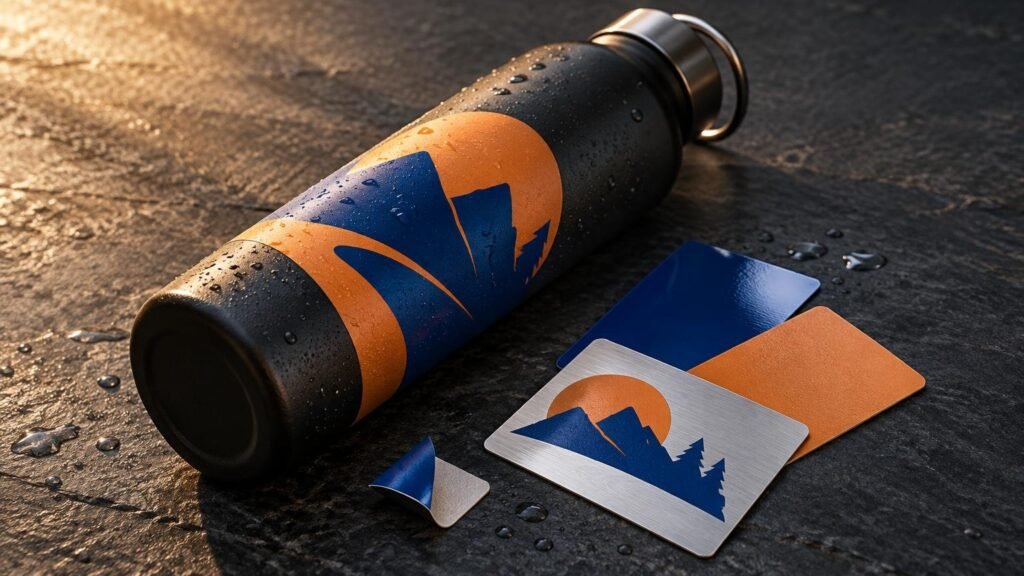
The best sticker material for outdoor use is usually printed permanent vinyl protected by a UV-resistant laminate. That construction is the practical all-rounder for smooth, relatively flat surfaces exposed to rain, sunlight and regular handling. The laminate protects the printed face, while the permanent adhesive gives the sticker a better chance of staying put through changing weather. CustomStickers describes its outdoor construction as waterproof vinyl with a UV-resistant laminate.
That answer changes when the surface has compound curves, rough texture, low-surface-energy plastic or constant foot traffic. In those cases, the correct adhesive and film construction matter more than simply finding a product labeled “weatherproof.”
| Outdoor job | Best starting construction | Important qualification |
|---|---|---|
| Smooth metal, glass or rigid plastic | Laminated printed vinyl with permanent adhesive | Confirm that the adhesive suits the exact surface |
| Flat signs and simple curves | Calendered vinyl with an outdoor-rated adhesive | Published durability depends on film, color and exposure |
| Compound curves and vehicle panels | Conformable cast vinyl or a dedicated wrap film | Installation skill and edge placement become critical |
| Temporary outdoor promotion | Outdoor-rated vinyl with removable adhesive | Expect a different service life from permanent adhesive |
| Rough or porous surfaces | Specialty high-tack system or another mounting method | Ordinary stickers may have too little adhesive contact |
| Outdoor floors | A complete exterior floor-graphic system | The film, overlaminate, texture and traffic rating must work together |
Why “vinyl” is only the beginning
A sticker is a system, not one material. The visible vinyl face, printed ink, protective laminate and adhesive all contribute to outdoor performance. A good vinyl film paired with the wrong adhesive can lift. An outdoor adhesive paired with an unprotected print can leave you with faded or scratched artwork.
For printed outdoor decals, make the protective overlaminate the default unless the manufacturer specifies another outdoor-rated construction. Avery Dennison’s guide to self-adhesive vinyl distinguishes calendered films for flat surfaces and simple curves from cast films intended for more demanding curved applications. It also notes that digitally printed vinyl commonly receives an overlaminate to protect the printed face.
Calendered vinyl or cast vinyl?
Use calendered vinyl for flat and gently curved surfaces
Calendered vinyl is the sensible choice for many signs, windows, equipment cases and other reasonably smooth surfaces. It can provide substantial outdoor life without the price or installation demands of premium cast film.
ORAFOL’s ORACAL 651, for example, is a 2.5-mil calendered PVC film with permanent solvent-based adhesive intended for medium-term indoor and outdoor lettering and marking. Its published vertical-exposure durability varies by color: up to six years for colors and transparent film, four years for metallics and three years for brilliant blue. ORAFOL’s ORACAL 651 technical data shows why a single “lasts outdoors” number is rarely the whole story.
Use cast vinyl for compound curves and demanding graphics
Cast vinyl is the better choice when a graphic must conform around pronounced curves, corrugations or complex vehicle panels. Avery Dennison’s 800 Premium Cast, for example, uses a permanent acrylic adhesive, is designed to conform to curved and corrugated surfaces and carries a stated durability of up to 10 years under its specified conditions.
Do not treat that specification as a universal life expectancy for every sticker. Orientation, climate, substrate, ink, laminate and installation period all affect outdoor durability. A south-facing decal in relentless sun has a different job from a sheltered window graphic.
Match the adhesive to the surface and removal plan
Permanent adhesive is usually the right starting point for a long-term outdoor decal, but it is not automatically compatible with every surface. Polyethylene and polypropylene are low-surface-energy plastics that can be difficult to bond. 3M makes dedicated graphic films for these substrates, which is a useful warning not to assume that ordinary permanent adhesive will grip every plastic bin, kayak component or molded case equally well.
If clean removal matters, order a removable construction rather than hoping a permanent sticker will peel away neatly later. Permanent and removable versions can have different expected service lives even within the same film family.
- Choose permanent adhesive for long-term signs, windows, metal equipment and similar stable surfaces.
- Choose a removable outdoor-rated adhesive for temporary campaigns or changing identification.
- Ask for a low-surface-energy adhesive when applying to polyethylene or polypropylene.
- Test a sample before committing to a large order on textured, coated, flexible or unfamiliar surfaces.
Waterproof does not cover every kind of exposure
Rain resistance, immersion, washing, abrasion and UV exposure are different demands. A sticker that handles occasional rain may not be suitable for continuous immersion, forceful washing or repeated scraping. 3M’s guidance for IJ180 exterior graphic film specifically does not treat water resistance as resistance to continuous immersion.
This is why waterproof and weatherproof sticker claims need to be read in context. For an exposed sign, UV stability and edge adhesion may decide the outcome. For a frequently handled object, abrasion around the perimeter may cause failure before sunlight does. For a submerged application, use a product specifically rated for that environment rather than relying on a general outdoor-sticker description.
Matte versus gloss outdoors
Matte and gloss are primarily visual and tactile choices when both finishes use an appropriate outdoor protective layer. Gloss tends to make saturated color and contrast feel punchier. Matte reduces glare and can look calmer on equipment, packaging or understated branding.
Do not confuse the look of the finish with the durability of the full construction. Ask whether the finish is a protective laminate, whether the printed ink is rated for the intended exposure and whether the edges will encounter rubbing or water. CustomStickers currently lists both matte and gloss options for its laminated outdoor stickers.
Surface preparation can make or break the sticker
Even premium outdoor vinyl struggles on dirt, wax, moisture, oxidation or deep texture. Long-lasting application needs a clean, dry, relatively nonporous and smooth substrate. Rough surfaces reduce adhesive contact, while porous materials can retain moisture that undermines adhesion. 3M’s substrate preparation bulletin also recommends cleaning immediately before application and applying dry because trapped moisture can interfere with contact and contribute to bubbles or early failure.
- Confirm that the surface is compatible with the chosen adhesive.
- Remove dirt, grease, wax and other contamination using the film manufacturer’s recommended method.
- Let the surface dry completely before positioning the sticker.
- Apply within the manufacturer’s temperature range; ORACAL 651, for example, specifies a minimum application temperature of 46°F.
- Press from the center outward, paying particular attention to edges and narrow points.
- Allow the adhesive time to build its bond before exposing the sticker to washing or severe weather.
Textured tumblers and coated surfaces deserve additional care because texture reduces the usable contact area. Our guide to stickers for powder-coated tumblers covers that narrower adhesion problem in more detail.
Do not use ordinary stickers as floor graphics
Outdoor foot traffic is a separate product category. A proper floor graphic needs a compatible base film and protective surface selected for the substrate, texture and pedestrian environment. 3M calls for a dry, clean and structurally sound surface, and its floor-graphic guidance says those systems are not designed for vehicular traffic.
A general laminated vinyl sticker may resist rain perfectly well and still be unsuitable underfoot. If people will walk on the graphic, order a rated floor-graphic system rather than improvising with standard outdoor decals.
What to check before ordering
- Film type: printed vinyl, cut calendered vinyl, cast vinyl or a specialty film.
- Laminate: UV-resistant protective laminate for printed outdoor graphics.
- Adhesive: permanent, removable, high-tack or formulated for low-surface-energy plastic.
- Surface: smooth, textured, porous, coated, flexible, flat or compound-curved.
- Exposure: sun orientation, rain, immersion, washing, abrasion, chemicals and temperature changes.
- Format: individual die cuts for handouts, transfer-tape lettering for cut graphics or larger installed panels.
- Proof: correct size, cut line, safe margins, color expectations and any white ink or underprint.
- Application requirements: minimum temperature, cleaning method and time before exposure.
If the sticker is headed for marine use, do not assume that a generic outdoor product covers every placement. Above-waterline graphics, frequently wet surfaces and submerged components create different requirements; our guide to custom boat decals and marine exposure explains those distinctions.
Our outdoor sticker recommendation
For an ordinary outdoor order on a smooth, stable surface, our pick is permanent printed vinyl with a UV-resistant laminate. It provides the best balance of print detail, weather resistance, handling durability and reasonable cost without pushing every buyer into vehicle-wrap film.
CustomStickers is our overall vendor pick for this use. In our hands-on testing, it earned 5/5 for quality, 5/5 for price and value, 5/5 for customer service and 4.5/5 for turnaround. Its current outdoor-sticker page lists waterproof vinyl with a UV-resistant laminate, matte and gloss options, and configurable quantities from one through 1,000. For its current custom sticker, label, material and artwork-preparation options, see details.
YouStickers is a close alternative. It also earned 5/5 for quality, value and customer service in our testing, and it currently describes its custom stickers as durable vinyl with a matte UV-protective laminate. The company appropriately notes that outdoor longevity still depends on placement, care and weather exposure.
Choose a specialty cast film or wrap system instead when the graphic must follow compound curves. Choose a dedicated adhesive when the substrate is polyethylene, polypropylene, rough or porous. And choose a complete rated system for floors, continuous immersion or other severe exposure. The word “outdoor” gets you into the right aisle; the surface, adhesive and protective layer decide what you should actually buy.
References
- Custom Vinyl Stickers | Waterproof and Durable – CustomStickers.com
- Outdoor Stickers | Quality Durable Waterproof Stickers – CustomStickers.com
- Self Adhesive Vinyl | Avery Dennison | Graphics
- Technical Datasheet
- ORACAL® 651™
- 800 Premium Cast | Avery Dennison | Graphics
- Categorizing Surface Energy | 3M Science of Adhesion Educational Series
- 3M™ Controltac™ Graphic Film
- 3M™ Controltac™ Graphic Film IJ180 | 3M United States
- 3M™ Print Wrap Film IJ180mC
- Application: Substrate Selection and Preparation
- Application: Floor Graphics
- Frequently Asked Questions – YouStickers