
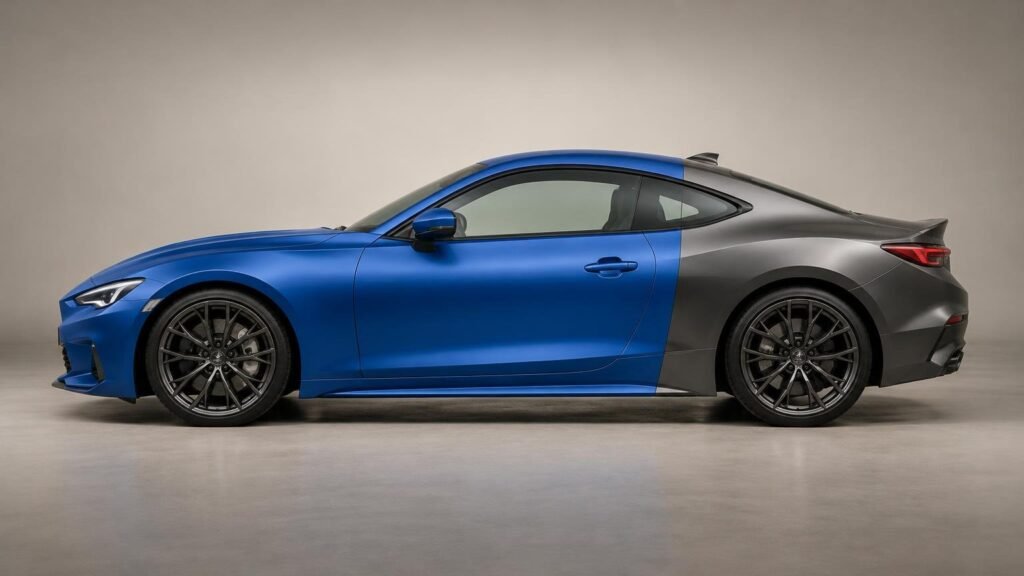
Choose a full car wrap when you want the vehicle to read as one complete color or graphic treatment from nearly every exterior angle. Choose a partial wrap when a roof, hood, stripe, accent area or commercial graphic can produce the intended effect without covering the entire body.
For most owners, the decision is less about whether a full wrap is “better” and more about where visual continuity matters. Full coverage gives a color change or large composition room to flow across the vehicle. Partial coverage costs less and can be more visually disciplined, but its stopping points must look intentional.
TLDR: Which wrap should you choose?
- Choose a full wrap for a dramatic color change, a vehicle-wide printed design or consistent coverage across most visible painted exterior panels.
- Choose a partial wrap for a contrasting roof or hood, stripes, lower-body graphics, chrome delete, a focused commercial layout or another treatment with natural visual boundaries.
- Choose decals or spot graphics when you only need a logo, lettering or isolated artwork rather than coordinated panel coverage.
- Choose paint-protection film, not ordinary wrap vinyl, when protection from road debris and impact damage is the primary goal.
A full wrap generally covers most visible painted exterior surfaces, but it does not automatically include door jambs, inner door areas or every painted opening. Those areas require considerably more labor and should be named explicitly in the quote. Avery Dennison’s vehicle-wrap guidance recommends asking an installer where seams will fall and how much disassembly the job includes.
Full wrap vs. partial wrap at a glance
| Decision factor | Full car wrap | Partial wrap |
|---|---|---|
| Best fit | Complete color changes and vehicle-wide graphics | Accents, selected panels and focused commercial graphics |
| Coverage | Most visible painted exterior panels | One panel, several panels or a planned portion of the body |
| Relative cost | Higher because it uses more film and labor | Lower when coverage and disassembly are limited |
| Design continuity | Strongest for one continuous color or composition | Depends on deliberate stopping points and the original paint color |
| Seams and joins | Still possible around complex geometry | Often easier to place at body lines or panel edges |
| Original paint visibility | Mostly hidden on wrapped exterior surfaces | Becomes part of the finished design |
| Installation scope | More preparation, panel work and edge finishing | Usually narrower, but complexity depends on the selected panels |
| Commercial use | Maximum graphic area and visual transformation | Efficient branding when the message remains large and simple |
Coverage is the first decision, not the last
“Full wrap” usually means most of the visible painted exterior, not literally every painted surface on the vehicle. Door jambs become noticeable when the new wrap color strongly contrasts with the factory paint, but wrapping those openings adds difficult edges, extra material and substantial labor. If hiding the original color whenever a door opens matters to you, request jamb coverage separately.
A partial wrap is deliberately limited, but that category covers several very different projects. It could be a black roof, a wrapped hood, racing stripes, rocker-panel accents, a rear-quarter graphic or coordinated commercial artwork spanning several panels. In fleet branding, 3M uses roughly one-third coverage as a common partial-wrap benchmark, but that is not a universal definition for personal accent work. 3M’s fleet graphics overview also separates partial wraps from decals and spot graphics such as logos, lettering and individual graphic elements.
If you are deciding between one isolated graphic and coordinated vinyl coverage, our guide to car decals versus vinyl wraps explains where the format changes. A decal adds a contained element. A partial wrap treats a larger section of the vehicle as a designed surface.
Cost depends on labor as much as square footage
A partial wrap normally costs less because it uses less material and requires fewer covered panels. That does not mean every small-looking project is cheap. Mirrors, bumpers, deep recesses, spoilers and compound curves can consume disproportionate installation time. A large, relatively flat side graphic may be easier than a much smaller collection of intricate trim pieces.
An installer interviewed by Avery Dennison offered a broad wrap example of about $2,000 to $10,000, with specialty chrome films potentially costing two to three times as much as standard film. Treat that as market context rather than a current local quote: vehicle size, film choice, paint condition, disassembly and coverage can move the final number considerably.
UTCarWraps does not post package-specific prices on its reviewed public pages. It asks prospective customers for the vehicle, desired coverage, paint condition, photos, location and timing before quoting. That is the right level of detail for any serious comparison because two quotes labeled “full wrap” may include different films, edge treatment, trim removal, jamb coverage or preparation.
Compare written scopes rather than headline totals. Ask each shop to identify the exact film, panels included, excluded openings, planned disassembly, visible seams, surface preparation, warranty terms and expected schedule. A cheaper quote is not a bargain if it quietly excludes the panels that make the color change convincing.
Partial wraps need deliberate stopping points
A strong partial wrap uses the vehicle’s architecture. Roof edges, beltlines, hood gaps, rocker lines, pillars and other natural panel boundaries can make the transition look intentional. An arbitrary stop in the middle of a smooth door or quarter panel is harder to resolve and may look unfinished unless the artwork creates its own convincing edge.
The factory paint also becomes an active design color. Black, white, silver and gray often cooperate easily with contrasting graphics. A vivid factory color may demand a more careful palette. Before approving a partial wrap, look at the composition from the front three-quarter, side, rear three-quarter and straight rear views. A clean side profile can still produce an awkward fragment around a bumper corner.
Roof wraps are a good example of efficient partial coverage. The roof already has clear boundaries, so a contrasting finish can change the silhouette without forcing vinyl across every panel. For a model-specific look at that decision, see our guide to black roof wraps on BMWs.
Full coverage does not guarantee an invisible seam
A full wrap creates visual continuity, but it is not automatically seam-free. Film width, panel size, recesses, body geometry, installation direction and access all affect where joins may be necessary. Ask the installer to point out likely seam locations before work begins, especially around bumpers, spoilers and unusually large panels.
Film direction also matters. For directional, metallic, pearl, textured and color-flip materials, 3M instructs installers to maintain orientation across panels and use material from the same production lot to support color consistency. A rotated panel can reflect light differently even when the film name and color are technically the same.
This is one reason a full wrap should be designed and installed as one coordinated project. Replacing or adding a panel later may introduce a slight color, texture or orientation difference. Save the film name and color code, but do not assume material purchased much later will be a perfect visual match.
Commercial wraps should prioritize recognition
A full commercial wrap provides the largest canvas, which helps when the vehicle needs a complete branded transformation or when artwork must flow across multiple sides. It can also overwhelm a weak layout. More square footage does not make tiny service lists, several phone numbers or crowded photographs easier to understand.
A partial commercial wrap can be the sharper buy when the factory paint works with the brand colors. Large lettering and a bold graphic concentrated across the doors and rear quarter can communicate more effectively than a busy full-body composition. One installer featured by Avery Dennison advises designing for viewers who may have only two or three seconds to take in a passing vehicle, favoring large logos and fewer small details.
For printed commercial graphics, the construction matters as well as the layout. Avery Dennison’s featured installer recommends digitally printable wrapping film with an overlaminate to help protect the print from UV-related fading. 3M distinguishes premium cast films suited to complex surfaces and longer-term work from calendered vinyl positioned more toward shorter campaigns.
Inspect the paint before choosing either option
Vinyl follows the surface beneath it. It does not reliably conceal rust, bubbling paint, dents, scratches, uneven touch-up work or body-filler problems. Some defects remain visible through the film, while unstable paint can contribute to lifting or premature failure.
Removal claims also depend on the underlying finish. Healthy factory paint presents a different situation from failing clear coat or poorly repaired paint. 3M’s warranty excludes paint pull during removal, and UTCarWraps warns that weak, failing or poorly repaired paint creates greater removal risk.
Before committing, wash the vehicle and inspect it in strong, angled light. Photograph chips, scratches, peeling clear coat and repaired areas. Give those photos to the installer and ask which problems require correction. This step matters for a full wrap because more questionable paint will be covered, but it also matters at the borders of a partial wrap where an unstable edge can undermine the installation.
Vinyl wrap and PPF solve different problems
Standard vehicle wrap vinyl is primarily an appearance and graphics material. Paint-protection film is intended for impact-related protection against hazards such as road debris, chips, scratches and stains. XPEL describes its PPF as a transparent polyurethane film, although colored PPF products also exist. XPEL’s PPF information describes its own color film as thicker than traditional vinyl and self-healing for minor marks; that description is specific to XPEL’s product rather than every colored protective film.
Do not select a full vinyl wrap because you expect it to perform like full-body PPF. A wrap can provide a sacrificial surface against light contact and grime, but ordinary wear, rocks, accidents and road debris are not the same as covered manufacturing defects. The cited 3M 2080 warranty, for example, addresses manufacturing issues such as yellowing, bubbling and cracking while excluding rocks, road debris, accidents, ordinary wear and paint pull during removal.
A mixed approach can make sense: vinyl for a roof accent, chrome delete or branding, and PPF for high-impact areas. PPF can also be installed over vinyl in some circumstances, but doing so adds cost, installation complexity, edge buildup and future-removal considerations.
What to include in your quote request
Send every shop the same scope so the quotes are comparable. Include:
- The year, make, model, trim and body style of the vehicle.
- Clear photos of every side, plus close-ups of chips, scratches, dents, peeling paint and repaired areas.
- Whether the project is a color change, printed graphics, commercial branding or a combination.
- A panel-by-panel coverage list, including the roof, hood, bumpers, mirrors, spoilers, pillars and rocker areas.
- Whether door jambs, inner edges or other painted openings must be covered.
- Your preferred color or finish, including whether it is gloss, satin, matte, metallic, textured or color-shifting.
- Any existing wrap, PPF, ceramic coating, stripes, badges or decals that may require removal or special preparation.
- The requested completion window and how long the vehicle can remain at the shop.
- A request for the exact film, planned seams, disassembly, care instructions and written warranty terms.
UTCarWraps lists vinyl wraps, color changes, commercial graphics, roof and hood wraps, chrome delete and PPF among its current Utah-area services. Its published starting estimate says a full color-change wrap usually takes two to four days, but the actual schedule depends on coverage, preparation and vehicle complexity. Exact material availability, warranty, timing and price should be confirmed in the project quote.
Our recommendation
Choose a full wrap if the goal is a convincing new body color, a continuous printed composition or a vehicle-wide commercial transformation. Confirm whether jambs are included, where seams will fall and which pieces will be removed for installation.
Choose a partial wrap if one or several defined areas can deliver the effect. Roofs, hoods, stripes, lower-body sections and bold commercial graphics often provide the best visual return per covered panel. The original paint must work as part of the palette, and each transition should land on a body line, panel edge or deliberate graphic boundary.
The best next step is to make a panel-by-panel coverage map before asking for prices. Mark each area as required, optional or unwrapped, then send the same map and vehicle photos to qualified installers. That turns “full versus partial” from a vague style question into a scope you can compare—and it makes the final quote far more useful.
References
- What to look for in a Color Change and Full Vehicle Wrap: a Q&A with Installer Blake Madsen | Avery Dennison
- Vinyl Car Wraps – utcarwraps.com
- Fleet Vehicle Graphics – Fleet Graphics and Signage | 3M US
- Contact – utcarwraps.com
- Application: Vehicle Color Change
- Questions and Answers for Wrap Shops
- 3M™ Wrap Film Series 2080 | 3M United States
- Frequently Asked Questions (FAQs) – XPEL Support
- Paint Protection Film – utcarwraps.com
- utcarwraps.com
- Home – utcarwraps.com
- How Long Does a Color-Change Wrap Take? Full-Coverage Variables – utcarwraps.com