
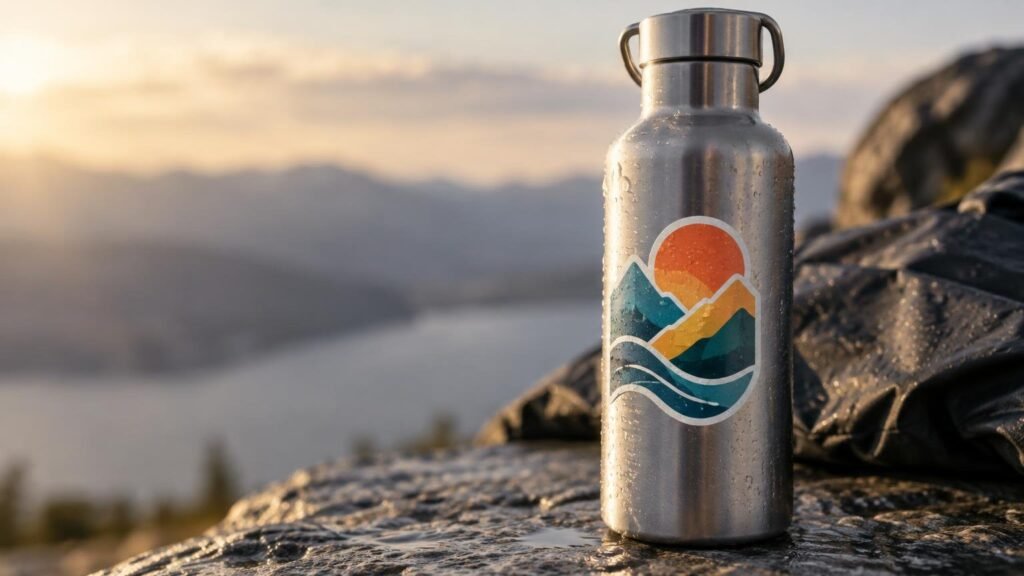
TLDR: Waterproof vs weatherproof stickers is not a choice between two universal performance grades. “Waterproof” usually points to water contact, while “weatherproof” suggests broader outdoor exposure such as rain, sunlight and temperature changes. Neither word alone guarantees dishwasher safety, long-term immersion, abrasion resistance or a specific outdoor lifespan. Match the sticker’s complete construction to the harshest condition it will face.
The practical difference between waterproof vs weatherproof stickers becomes clear when you picture the job. A laptop sticker may only encounter an occasional spill. A bottle sticker gets wet, handled and washed. A kayak decal deals with water, sun and scraping. An outdoor sign faces months or years of UV, heat, cold and rain. Those are four different durability problems, even if every product page uses reassuring language about water.
Waterproof vs. weatherproof at a glance
| Exposure | What the sticker must resist | Does “waterproof” establish it? | Does “weatherproof” establish it? |
|---|---|---|---|
| Occasional spills | Brief surface water without ink damage or immediate lifting | Possibly, but check the stated conditions | Possibly, but check the stated conditions |
| Rain and snow | Repeated water exposure plus changing temperature | Not by itself | More relevant, but still not a measurable guarantee |
| Direct sunlight | UV-related fading and material degradation | No | Suggests outdoor suitability, but verify a stated outdoor rating |
| Dishwasher use | Water, detergent, heat, spray pressure and repeated cycles | No | No |
| Immersion | Continuous water exposure at the face, edges and adhesive | No universal duration is implied | No |
| Scraping and handling | Scuffs, scratches and edge wear | No | No |
| Chemicals or salt spray | Resistance of the print, film and adhesive to a particular substance | No | No |
Treat both terms as starting points, not specifications. A useful product description names the material, adhesive, protective layer, compatible surface and exposure limits. A vague adjective without those details leaves the most important questions unanswered.
A durable sticker is a complete system
Sticker performance does not come from the face material alone. The printed image, protective finish, adhesive, application surface and environment all affect the result. The UL Solutions marking and labeling guidance similarly treats durable labeling as a system in which material, adhesive, surface and exposure conditions matter. Evaluations can consider moisture, sunlight, temperature, chemicals, adhesion and legibility rather than reducing durability to one word.
Face film or label material
The facestock is the visible base carrying the design. Film-based materials are commonly chosen for wet or outdoor applications because they do not behave like ordinary unprotected paper when exposed to water. That still does not tell you how the ink, coating, adhesive or cut edges will perform.
Printed image and protective layer
A laminate or protective coating can reduce scuffing and shield the printed surface from environmental exposure. It is especially useful on bottles, toolboxes, helmets and other objects that are handled frequently. However, laminate does not automatically seal every cut edge or convert an unsuitable adhesive into an immersion-rated one.
Product-specific documentation shows why details matter. Avery Dennison says one of its overlaminates is designed to protect graphics from scuffs and scratches as well as UV, temperature and salt-spray exposure. Its published durability figures differ between vertical and horizontal installations, illustrating that even a named protective film does not have one lifespan in every position.
Adhesive and application surface
A printed image can remain perfectly legible while the sticker peels away. Adhesion depends on the adhesive, the surface material, texture, cleanliness, curvature and application conditions. Powder coating, textured plastic and low-surface-energy plastics can be harder to stick than smooth glass or painted metal.
This is why a “waterproof vinyl” description can still produce a poor result on the wrong object. For textured drinkware, use the preparation and placement advice in our guide to stickers for powder-coated tumblers. For polyethylene boats and other difficult hull materials, see the more specialized guidance on custom kayak stickers.
Five exposures to check before ordering
1. Brief water contact or prolonged immersion
A splash, a rainstorm and a week underwater are not equivalent. Ask whether the claim covers occasional contact, repeated wetting or continuous immersion. Pay attention to edges: water can work at a poorly adhered edge even when the face film itself is unaffected.
Marine labels demonstrate how demanding the stronger claim can become. UL’s description of BS 5609 marine-use testing includes the facestock and adhesive as well as printing durability, abrasion and permanence. That kind of bounded testing is much more informative than the word “waterproof” by itself.
2. UV and outdoor weather
Water resistance does not establish sunlight resistance. Outdoor graphics also encounter UV, temperature changes, humidity and pollution. Avery Dennison/Mactac identifies those variables, along with ink type, ink load, altitude and graphic orientation, as factors in outdoor durability. The bulletin describes horizontal and south-facing graphics in hot, high-UV conditions as especially severe exposures.
That orientation point matters in the real world. A decal on a vertical mailbox side may age differently from the same construction placed flat on its sun-baked lid. An RV side graphic also faces a different exposure pattern than one applied to a roof surface. For larger vehicle applications, our guide to RV and camper decal materials explains how panel construction and installation affect the choice.
3. Dishwasher cycles
“Waterproof” does not mean dishwasher-safe. A dishwasher combines hot water, detergent, spray force, heat and repeated cycling. Look for a claim that names the compatible surface, rack position, drying method and number of cycles.
Avery Dennison provides a useful example of this specificity for certain Siser EasyPSV materials: it states up to 80 top-rack washes with heat dry on glass, porcelain and stainless steel, while noting that performance may vary by font. That is a bounded claim for particular materials and conditions—not a benchmark for every bottle sticker.
If the sticker is going onto a reusable bottle, choose around your actual cleaning routine. Our water bottle sticker guide covers material, sizing, placement and care in more detail.
4. Abrasion and handling
A sticker can resist water but look tired quickly when it is rubbed against cup holders, bag pockets, branches or cleaning brushes. Lamination often matters more for this job than a bare waterproof claim. Rounded corners and well-adhered edges also reduce obvious snag points, although no shape makes a sticker immune to scraping.
5. Chemicals, salt and cleaners
Fuel, solvents, sunscreen, concentrated cleaners and salt exposure create separate compatibility questions. Do not assume resistance to water establishes resistance to another liquid. ASTM D6688, for example, addresses the relative resistance of printed matter to liquid chemicals, including effects such as bleeding, discoloration and loss of gloss. A relevant test or manufacturer statement should name the substance and conditions involved.
What to choose for common sticker jobs
| Use case | Priority | What to request |
|---|---|---|
| Laptop or indoor case | Clean print, handling resistance and suitable removability | Film or coated material, scratch protection and an adhesive appropriate for the surface |
| Water bottle or tumbler | Water, repeated handling and the actual washing routine | Compatible surface list, protective layer and a specific hand-wash or dishwasher statement |
| Car window or painted panel | UV, rain, temperature changes and safe surface compatibility | Outdoor-rated film, compatible adhesive, orientation-based durability information and removal guidance |
| Mailbox or outdoor sign | Long-term UV and weather exposure | Published outdoor conditions, laminate or protective film, and surface-preparation instructions |
| Kayak or outdoor equipment | Water, UV, difficult plastic and abrasion | Adhesive compatible with the exact substrate plus realistic abrasion expectations |
| Boat or marine label | Water, salt, abrasion and possibly regulated permanence | A marine-specific construction or applicable tested standard rather than a generic waterproof claim |
When comparing custom sticker options, describe the surface and harshest exposure instead of asking only for “waterproof stickers.” A useful request would be: “I need individual decals for powder-coated bottles that are hand-washed and handled daily,” or, “I need a vertical outdoor decal for painted metal in full sun.” That gives the printer enough context to recommend a construction rather than a buzzword.
A pre-order durability checklist
- Identify the exact application surface, including whether it is smooth, textured, curved, flexible or difficult plastic.
- Define water exposure as spills, rain, washing, pressure washing or continuous immersion.
- State whether the sticker will live indoors, outdoors or in a vehicle.
- Ask for the face material, printing method and protective laminate or coating.
- Confirm that the adhesive is recommended for the application surface.
- Request surface-cleaning and minimum application-temperature instructions.
- For outdoor use, ask what lifespan conditions and orientation the rating assumes.
- For drinkware, request explicit hand-wash or dishwasher terms rather than relying on “waterproof.”
- Name any cleaners, fuel, salt or chemicals likely to touch the sticker.
- Consider rubbing, scraping and edge impacts separately from water resistance.
- Check warranty exclusions and care requirements before placing a large order.
Common questions about waterproof and weatherproof stickers
Are weatherproof stickers waterproof?
They may resist rain, but the term does not establish indefinite immersion or dishwasher performance. Check the seller’s stated water conditions, material and adhesive specifications.
Can a waterproof sticker survive direct sun?
Not necessarily. Water resistance and UV durability are separate properties. Look for an outdoor rating that states the construction, exposure conditions and orientation where possible.
Does laminate make a sticker waterproof?
Laminate can protect the printed face from moisture, UV and abrasion, depending on the product. It does not automatically seal the cut edges, improve an incompatible adhesive or guarantee immersion performance.
Will a weatherproof sticker survive a car wash?
Do not assume it will. Water pressure, brushes, cleaners, waxes and vulnerable edge placement can be harsher than ordinary rain. Ask whether the specific construction is recommended for vehicle exteriors and automated or pressure washing.
The practical verdict
Choose stickers by exposure, not adjective. For occasional spills, a film-based sticker with a suitable adhesive may be enough. For bottles, verify the washing method. For exterior decals, prioritize UV, temperature and orientation-specific durability. For immersion, marine use or chemical contact, demand a claim or test that directly covers that environment.
Before ordering, write down the surface and the single harshest thing that will happen to the sticker. Then buy only when the material, adhesive and protective layer are documented for that condition. That one step is more useful than choosing between “waterproof” and “weatherproof” on the strength of the product name alone.
References
- Marking and Labeling Systems FAQs | UL Solutions
- Labels – Surfaces and Conditions | UL Solutions
- Marking and Labeling Systems Program | UL Solutions
- DOL 7460 PVC-Free Overlaminate | Avery Dennison | Graphics
- UL Solutions
- TB 7.5 Outdoor Durability of Mactac Graphics – Self-adhesive films – V7 – EN (AD-Public)
- Siser® by Avery Dennison | Avery Dennison | Graphics
- D6688 Standard Practice for Relative Resistance of Printed Matter to Liquid Chemicals by a Sandwich Technique