
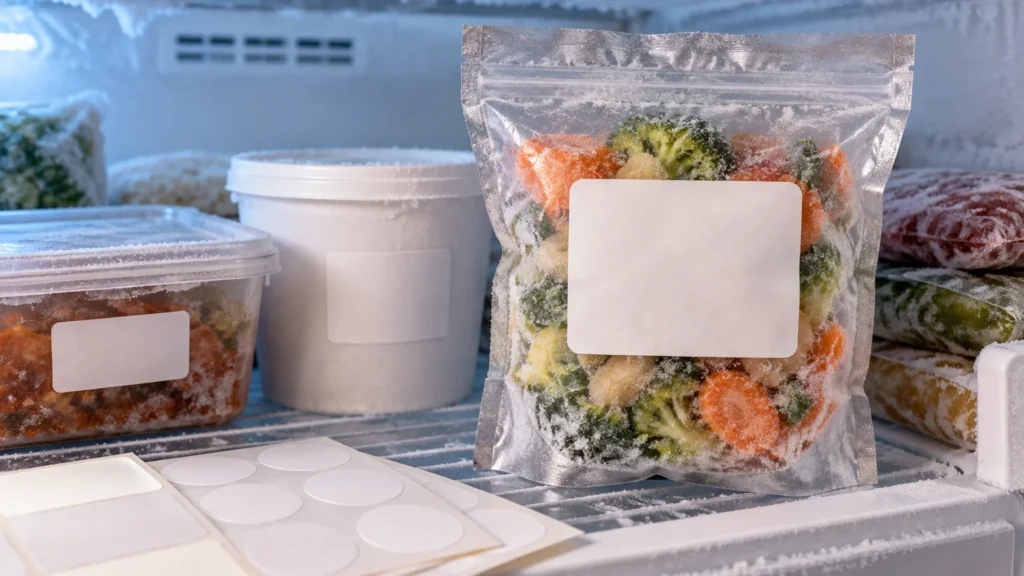
TLDR: Specify the package, temperature and application conditions
The best freezer safe stickers for food packaging use a cold-temperature adhesive matched to the package surface, plus a facestock and print system that can tolerate freezing, handling and thawing. Do not buy from the words “freezer safe” alone. Check both the minimum application temperature—the temperature at which the label can first be attached—and the service-temperature range it can withstand after application.
For freezer safe stickers for food packaging, start by identifying whether the label will be applied to a room-temperature package before freezing or directly to an already cold, damp or frosted package. Then match the adhesive to the actual substrate: a coated carton, glass jar, rigid polypropylene tub and flexible polyethylene pouch are four different labeling jobs.
- Apply labels before freezing whenever the production workflow allows it.
- Use a cold-temperature adhesive documented for the package material and application temperature.
- Treat frost, condensation and oil as separate adhesion problems rather than assuming a stronger adhesive will overcome them.
- Choose film over unprotected paper when the label will encounter substantial moisture, flexing or condensation during thawing.
- Request documentation for the complete construction if any part of the label may contact food.
- Test production labels on filled packages through application, freezing, storage, handling and thawing before placing a full order.
Application temperature and service temperature are different specifications
A label may be able to remain on a package at freezer temperature without being able to bond properly when first applied at that temperature. Minimum application temperature describes the coldest surface or environment in which the pressure-sensitive adhesive is intended to be applied. Service temperature describes the range the finished bond is intended to tolerate afterward. Freezer-grade constructions can therefore have different application and storage limits.
This distinction changes what you need to order. If labels go onto clean packages in a room-temperature packing area and the products are frozen later, the adhesive has time to wet out and establish its bond under favorable conditions. If labeling happens inside a cold room or after freezing, the adhesive must be designed for that lower application temperature and the actual surface condition.
Do not assume there is one standard freezer-label threshold. Bostik, for example, states that its Thermogrip H2259-01 freezer-grade pressure-sensitive adhesive can be applied at temperatures as low as -15°F. That is a specification for that particular adhesive, not a universal definition of “freezer safe.”
When requesting a quote, give the label supplier two temperatures: the package-surface temperature at application and the lowest expected storage temperature. Also explain whether the package travels immediately into a freezer or has time at a warmer temperature before freezing.
Match the adhesive to the frozen-food package
Package material matters because adhesives do not spread and bond equally well on every surface. Glass and coated paperboard are often more straightforward than low-surface-energy plastics such as polyethylene and polypropylene. Avery Dennison positions its C2580 adhesive technology for difficult substrates including HDPE and PP, illustrating why these plastics may require an adhesive developed for them rather than a generic permanent label adhesive.
| Package | Main labeling challenge | What to specify |
|---|---|---|
| Flexible PE or PP pouch | Low-surface-energy plastic, flexing and wrinkles | Adhesive documented for the exact film; a conformable facestock; testing on filled pouches |
| Rigid PP or HDPE tub | Difficult plastic surface and possible condensation | Adhesive designed for the substrate and cold application conditions |
| Coated frozen-food carton | Cold surface, coating variation and abrasion | Compatibility with the carton coating plus enough print protection for distribution |
| Glass jar or bottle | Condensation and curved surfaces | Cold-temperature adhesive, moisture-resistant construction and a label sized to avoid edge lift |
| Vacuum pack | Flexible film, wrinkles and package movement | Conformable label construction tested before and after the pack is drawn down |
| Reusable plastic container | Low-energy plastic plus cleaning or handling | A construction matched to both the plastic and the intended removal or permanence requirement |
Polyethylene deserves particular attention. It appears in pouches, liners, containers and other flexible packaging, but different films can have different surface treatments, textures and additives. Advice for exterior decals on polyethylene, such as our guide to adhesion on polyethylene kayak surfaces, reinforces the same buying principle: identify the substrate first and test the adhesive on the real object.
Package shape also matters. A stiff label that looks fine on an empty pouch may bridge over wrinkles or pull against the film once the pouch is filled. On a small tub, placing the label too close to a curved edge can create constant lifting force. Send filled-package dimensions and samples to the label supplier rather than specifying the package only as “plastic.”
Dry, cold, damp, frosted and oily are not the same surface
A freezer label performs best when applied with firm, even pressure to a clean surface. A cold but dry package is a different problem from one covered in condensation or frost. Water, ice crystals, oil, food residue and loose powder can prevent the adhesive from making intimate contact with the package.
Avery Dennison’s cold-temperature guidance distinguishes among cold, moist and slightly frosted application conditions and recommends testing the complete label construction in its intended use. A material approved for a cold, dry surface should not automatically be treated as suitable for visible frost.
If packages are emerging from a filling, chilling or freezing step with condensation, the most dependable fix may be changing the labeling point. Applying the label before the package becomes wet or frozen can be more effective than trying to specify an adhesive that must bond through contamination. Where the production sequence cannot change, disclose the moisture or frost condition and request a construction documented for it.
Oil requires the same honesty. Slightly oily packaging may need a specialized adhesive, but a heavily contaminated seal area is also a process-control problem. Review filling and sealing equipment, label placement and wipe-down procedures. Our guide to labels for containers exposed to oil and heat explains how surface condition and handling can change an otherwise sensible label choice.
Choose a label construction that survives storage and thawing
The adhesive keeps the label attached, but the facestock and printed surface determine whether it stays readable. Frozen packages can be rubbed against cartons, freezer shelves and neighboring products. When removed from storage, they may collect condensation or flex as their contents thaw.
Paper labels
Paper can be a practical, economical choice for dry cartons labeled before freezing, particularly when the package remains protected and is discarded without a wet thawing cycle. The tradeoff is moisture sensitivity. Unprotected paper can soften, wrinkle or lose print clarity when condensation reaches it.
Film labels
Film facestocks are generally the safer starting point for pouches, tubs, glass and packages expected to become wet during thawing. BOPP, polyethylene and polyester are not interchangeable, however. Conformability, stiffness, clarity, print compatibility and resistance to tearing vary by construction. Ask the converter to recommend a complete film-and-adhesive combination instead of choosing a facestock name in isolation.
Print protection and variable data
Product graphics may need a protective coating or laminate when abrasion and moisture are substantial. The correct protection depends on the print process and label construction. Our advice on materials and protection for frequently wet stickers provides a useful comparison, although food-package labels still need their own adhesive and compliance review.
Batch numbers, packed-on dates, best-by dates, weights and barcodes may be printed after the main labels are produced. Tell the supplier whether variable information will be added by direct thermal, thermal transfer, inkjet or another system. A beautiful face material is not useful if the production printer cannot mark it cleanly or if the variable print rubs off during frozen distribution.
Test barcodes at the smallest intended size, after freezing and after condensation forms. Check them with the scanners used in packing, inventory and checkout—not only with a phone. Wrinkles, frost, low contrast, curved containers and damaged print can all interfere with scanning.
Exterior labeling is different from direct food contact
“Freezer safe” describes temperature performance; it does not establish that an adhesive, ink, coating or complete label is suitable for direct food contact. FDA identifies packaging adhesives and colorants among the substances that may come into contact with food. FDA’s food-contact packaging overview explains the broader regulatory category.
A label attached to the outside of an intact pouch is a different use from one placed directly on food, inside a package or across an opening where an edge could contact the contents. Federal rules at 21 CFR 175.125 address pressure-sensitive adhesives used as the food-contact surface of labels or tapes under specified conditions, including certain uses involving processed frozen fruits and vegetables. Applicability depends on the material and intended use.
If direct, incidental or edge contact is possible, request documentation for the exact adhesive, facestock, ink, coating and printing process. Describe the food, contact location, temperature, storage duration and whether the product is fatty, oily or aqueous. A generic statement about the base label material is not a substitute for documentation covering the finished construction.
Plan the required product information before designing
Most prepared foods, including frozen foods, require food labeling in the United States. FDA resources cover areas such as Nutrition Facts and allergen information, while the exact obligations depend on the product, responsible agency and business situation. Meat and poultry products may fall under different federal oversight, and state or local requirements can also affect the package.
Build the information hierarchy before choosing label dimensions. Depending on the product and applicable rules, space may be needed for the statement of identity, net quantity, ingredient and allergen information, Nutrition Facts, business details, handling instructions, lot coding and date fields. Do not finish an attractive front label and then discover that the required copy will only fit at an unreadable size.
Marketing language needs review too. FDA has compliance-policy guidance on food identity and terms including “fresh” and “frozen,” so those words should be evaluated for the specific product rather than treated as decorative package copy.
How to order and test freezer labels
Give the converter a short operating specification instead of asking only for freezer-safe labels. If sourcing from a custom sticker printer, confirm that it can provide the product-specific adhesive and documentation your packaging process requires.
- Identify the package substrate precisely: coated paperboard, glass, PET, PE, PP, HDPE or a named flexible-film structure.
- Record package temperature and surface condition at the exact moment of labeling.
- State the lowest storage temperature, expected storage duration and whether the package will be thawed before the label is removed.
- Describe moisture, frost, oil, flexing, abrasion and handling during packing and distribution.
- List the printing method for dates, lots, weights and barcodes.
- Explain whether the label is exterior-only or could contact food at an edge, seam or opening.
- Request small production samples made with the proposed facestock, adhesive, ink and protective finish.
- Apply samples using the same equipment, pressure, speed and package condition used in production.
- Freeze, store, handle and thaw the samples through the intended cycle.
- Inspect edge lift, wrinkles, tunneling, paper damage, ink loss and barcode readability before approving the order.
Test more than one package from each run. Include labels placed near seams and curves, and compare packages from the beginning and end of the labeling shift. For hand application, check whether workers can position the label consistently while wearing gloves. For automatic application, make sure the facestock, liner and adhesive release work at production speed.
Frequently asked questions
Can a freezer-safe label be applied directly to a frozen package?
Only when its documented minimum application temperature and surface-condition guidance cover that process. A label capable of remaining attached in frozen storage may still require application to a warmer, dry package. Frost or condensation creates an additional challenge beyond temperature.
What adhesive works on PP, PE and HDPE packaging?
Specify an adhesive designed and documented for the exact low-surface-energy plastic. Do not rely on “permanent adhesive” as the complete specification. Film formulation, surface treatment, curvature, flexing and application temperature can all affect the result.
Are film labels always better than paper in a freezer?
No. Paper can work well on dry, protected cartons, especially when applied before freezing. Film is usually the stronger starting point when the package flexes, becomes wet during thawing or faces substantial abrasion. The adhesive still has to match the substrate and application conditions.
Will freezer labels stick over frost?
Some cold-temperature adhesive constructions are designed for moist or slightly frosted conditions, but this must be documented for the proposed product. Heavy frost prevents dependable surface contact. When possible, remove the frost or label before it forms.
Does freezer-safe mean food-safe?
No. Temperature capability and food-contact suitability are separate questions. For any direct or incidental food-contact scenario, obtain documentation covering the intended use and the complete label construction.
The practical recommendation
For most frozen-food packaging, the best workflow is to apply labels to clean, dry packages before freezing. Use a cold-temperature adhesive matched to the exact carton, glass or plastic substrate, then choose paper for protected dry cartons or a suitable film construction where flexing, condensation and abrasion are expected.
Before ordering a full run, test the complete production label on filled packages through the real packing, freezing, storage, handling and thawing cycle. That small trial will tell you far more than a generic “freezer safe” product description—and it gives the supplier the information needed to recommend the right construction.
References
- Bostik Thermogrip® H2259-01 freezer grade label Hot Melt PSA| Bostik.com | Bostik US
- Product Overview C2580 Adhesive Technology
- Factsheet
Adhesives for
Cold-temperature Labellin - Food Packaging & Other Substances that Come in Contact with Food – Information for Consumers | FDA
- 21 CFR § 175.125 – Pressure-sensitive adhesives. | Electronic Code of Federal Regulations (e-CFR) | US Law | LII / Legal Information Institute
- Nutrition, Food Labeling, and Critical Foods | FDA
- How to Start a Food Business | FDA
- www.fda.gov