
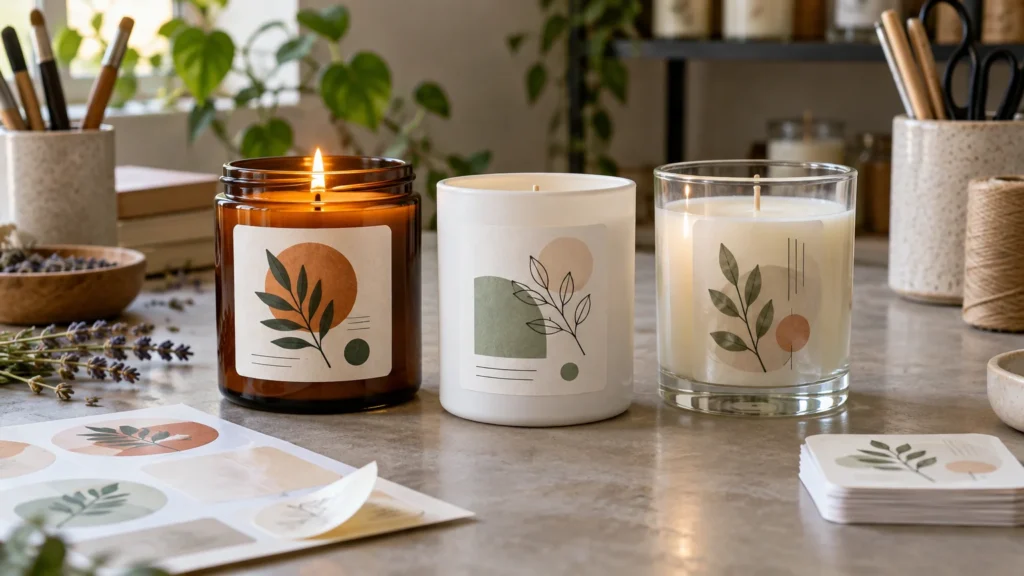
TLDR: The best labels for candle jars are paper labels for a tactile, low-exposure presentation; white film labels for stronger resistance to moisture, oil and repeated handling; and clear film labels when you want the container to show through. Measure the jar’s usable label panel rather than choosing by wax capacity. For most retail candles, use a separate front branding label and bottom or rear safety label so neither one has to do too much.
Choosing the best labels for candle jars starts with three questions: Is the container straight or tapered, how much handling or oil exposure should the label tolerate, and where will the product identity and safety information go? A beautiful stock is still the wrong choice if it wrinkles around a curved jar, disappears against dark glass or leaves no practical place for warnings.
For a dependable all-around choice, start with a white film label sized to fit one smooth, reasonably flat section of the container. It gives artwork an opaque background and is a practical fit for candles that will be handled at markets, shipped or exposed to small amounts of moisture and fragrance oil. Choose paper when its texture is central to the packaging and the candle will remain relatively dry and clean.
Quick selector for the best labels for candle jars
| Label material | Best fit | Main advantage | Watch for |
|---|---|---|---|
| Paper | Boutique packaging, gift candles and dry indoor handling | Tactile appearance with many natural, uncoated or textured looks | More vulnerable to moisture, oil marks and scuffing |
| White film | Frequently handled candles, bathrooms, kitchens and shipped products | Opaque print surface with better resistance to moisture and oils | A glossy stock may feel less handcrafted than textured paper |
| Clear film | Minimal branding on clear or colored glass | Lets the container remain part of the design | Transparent areas can reduce contrast; white elements may require white ink |
| Metallic or specialty film | Limited editions and decorative focal labels | Strong visual effect under directional light | Small type and low-contrast artwork can become difficult to read |
Avery distinguishes thicker paper labels from film materials intended for candle applications involving handling, moisture or oils. It also advises applying labels to clean, dry and cooled containers. That makes film the safer default when durability matters, but it does not make paper a bad choice. Paper works well when the packaging experience depends on texture and the label is unlikely to encounter oily hands, condensation or bathroom humidity.
Paper, white film or clear film?
Choose paper for warmth and texture
Paper labels suit apothecary jars, kraft packaging and subdued botanical designs. Uncoated or lightly textured paper can make a candle feel more like a small-batch object than a mass-produced container. The tradeoff is visible wear: oil can darken the stock, moisture can affect the surface, and frequent handling can soil pale colors.
Paper is most convincing when the material is part of the design. Use a simple palette, allow generous space around small text and order a physical sample before committing to a long run. Fine texture can soften tiny lettering and delicate lines.
Choose white film for the practical default
White film gives printed colors a consistent base regardless of whether the jar is amber, frosted, black or clear. It is the easiest material to recommend for a working product line because it balances presentation with resistance to routine handling.
Film does not automatically solve every adhesion problem. The adhesive still has to match the jar surface, and the label must fit without being forced over a taper, seam or tight compound curve. Request material samples when using heavily frosted, powder-coated or unusually textured containers.
Choose clear film for a label-free look
Clear film works best when the glass color, wax or container finish should remain visible. Its design requirements are less forgiving. Dark artwork can disappear on amber glass, pale artwork can vanish against white wax, and any unprinted area will show the surface underneath.
Ask whether the production method includes white ink if the design needs opaque white lettering or a controlled white base beneath colored elements. Without an underprint, printed colors may appear translucent. Test the label on a filled candle because an empty clear jar can look very different from the final product.
Measure the usable label panel, not the candle capacity
An “8 oz candle label” is not a dependable size category. Two containers with the same nominal capacity may have different diameters, shoulders, tapers, seams and flat labeling areas. Avery’s container guide, for example, suggests different formats for an 8 oz jelly jar, an 8 oz tin and certain medium straight-sided jars. The container controls the dimensions.
- Find the smoothest label panel. Avoid measuring across shoulders, raised logos, seams, pronounced curves or changes in diameter.
- Measure the available height at several points. Use the smallest result so the label does not creep into a curved area.
- For a wrap label, measure circumference at the exact height where the label will sit. Subtract a deliberate gap rather than designing the ends to touch.
- Make a paper mockup at full size. Tape it lightly to a finished jar and inspect it from the front, side and normal shelf distance.
- Test tapered containers with more than one sample. A long rectangle may wrinkle or rise at an edge even when its measured width looks correct.
Straight-sided jars and tins can usually accept a larger rectangle or wrap. Tapered jars are better candidates for a smaller front label, a properly shaped label created from the container profile, or multiple separate labels. Reducing width is often cleaner than trying to make a large rectangular label conform to a changing circumference.
Choose a label format that matches the container
| Format | Use it when | Practical consideration |
|---|---|---|
| Front label | Brand and scent name should be the focal point | Easy to align and forgiving on mildly tapered containers |
| Wrap label | The container is straight-sided and needs more information | Requires accurate circumference and a planned seam or gap |
| Lid label | The lid is prominent in displays or shipping boxes | Do not make it the only location for information customers need after opening |
| Bottom label | You need a discreet place for safety or batch information | Size it around any recessed base, feet or molded markings |
| Rear label | The jar has enough usable area for a second readable panel | Useful for separating brand design from instructions and business details |
A separate front and safety-label system is usually the cleanest option. Let the front carry the brand, product identity and scent. Place warnings and supporting information on a readable rear or bottom label. The National Candle Association says candle fire-safety labeling standards address three core rules: burn within sight, keep away from combustibles and keep away from children.
The U.S. Consumer Product Safety Commission identifies ASTM F2058 as the standard specification for candle fire-safety labeling. It also identifies ASTM F2179 as covering soda-lime-silicate glass containers produced for use as candle containers. Makers developing products for sale can use the CPSC candle business guidance as a starting point for the relevant standards and safety resources.
How to prevent bubbles, wrinkles and lifting edges
Apply labels only after the poured candle and container have fully cooled. The outside of the jar should be clean and dry, with no wax dust, fragrance oil, fingerprints or cleaner residue where the adhesive will sit. This preparation is specifically included in Avery’s candle-label application guidance.
- Set a simple placement guide. A small jig or marked work surface is more consistent than aligning every label by eye.
- Anchor one edge or the center first, depending on the label shape. Do not drop the entire adhesive face onto the jar at once.
- Smooth outward with steady pressure while keeping the remaining label away from the surface.
- Inspect the first few jars from normal viewing distance. A technically small tilt can become obvious when several candles sit together.
- Allow freshly labeled jars to rest before packing them tightly so edges are not immediately rubbed or caught.
If edges continue to lift, first check whether the label crosses a taper or rounded section. Then check for surface coatings, oil residue and insufficient pressure during application. Changing to a stronger adhesive may not help if the label shape itself is fighting the container.
Plan retail information before finalizing the artwork
Do not fill every available inch with branding and then try to squeeze required information into the remaining space. Begin with the information hierarchy, assign each item to a panel and design the visual label around that plan.
- Clear product identity, such as scented candle or soy wax candle, without using a misleading description
- Net quantity in the appropriate location and format for the market where the product will be sold
- Manufacturer, packer or distributor identification and address where applicable
- Fire-safety label or tag with readable instructions
- Scent or variant name, batch information and business contact details as needed
- Substantiation for marketing claims before those claims are printed
NIST Handbook 130’s Uniform Packaging and Labeling Regulation provides a model framework covering package identity, quantity declarations and business identification. NIST describes the handbook as a compilation of uniform laws and regulations, so candle sellers should also check how the relevant provisions are adopted and enforced in every jurisdiction where they sell.
Claims require their own review. The Federal Trade Commission says an unqualified Made in USA claim needs support that the product is all or virtually all made in the United States. Even flag imagery can contribute to an implied origin message depending on the overall presentation. Avoid treating decorative patriotic graphics as separate from the label’s marketing claims.
Mosquito-control or insect-repellent language moves a candle into a different labeling context from an ordinary home-fragrance product. EPA records include registered citronella candle products labeled for outdoor domestic use and mosquitoes. If the label promises to repel, control or protect against insects, review the applicable EPA requirements before printing inventory.
Printable sheets or professionally printed labels?
Home-printable sheets make sense for prototypes, seasonal scents and very small batches. They let you revise dimensions quickly after testing a new jar. The main challenge is consistency: printer alignment, ink durability, edge finish and manual application can vary across a run.
Professionally printed labels are the better production route once the same container and artwork repeat reliably. Rolls support faster application and pack-out, while sheets remain convenient when several scent variants are produced in small quantities. Individual pieces can work for promotional extras or branding formats that behave more like stickers than packaging labels. If that is the format you need, custom printed stickers are another route to consider.
Before ordering a full run, get a material sample or the smallest practical quantity. Apply it to a finished, cooled candle and handle it as a customer would. Check color and contrast under normal room lighting, rub the edges, place the jar in its shipping box and inspect the label again after several days. If you are still comparing standard custom-sticker vendors for small branded pieces, our CustomStickers.com and StickerYou comparison explains the practical differences.
Final recommendation
For most candle businesses, start with an opaque white film front label plus a separate bottom or rear safety label. This combination gives artwork a predictable print base, handles routine moisture and oil exposure better than ordinary paper, and keeps the main design from becoming crowded.
Move to paper when texture is essential to the brand and the product will remain in a relatively dry, controlled setting. Use clear film when the glass is part of the design, but test opacity and contrast on the filled jar. Most importantly, measure the actual usable panel and make a physical mockup before ordering. Container geometry—not the number of ounces in the candle—is what determines whether the finished label looks intentional and stays flat.
References
- www.avery.com
- Popular Candle Container Label Sizes | Avery.com
- Candle Labels 101: Understanding Product Claims & Safety Instructions – National Candle Association
- Candles Business Guidance | CPSC.gov
- NIST HB 130-2026: Uniform Laws and Regulations in the Areas of Legal Metrology and Fuel Quality
- NIST Handbook 130 – Current Edition | NIST
- Complying with the Made in USA Standard | Federal Trade Commission
- Labels for INSECT REPELLENT CITRONELLA CANDLE (8879-1) | US EPA