
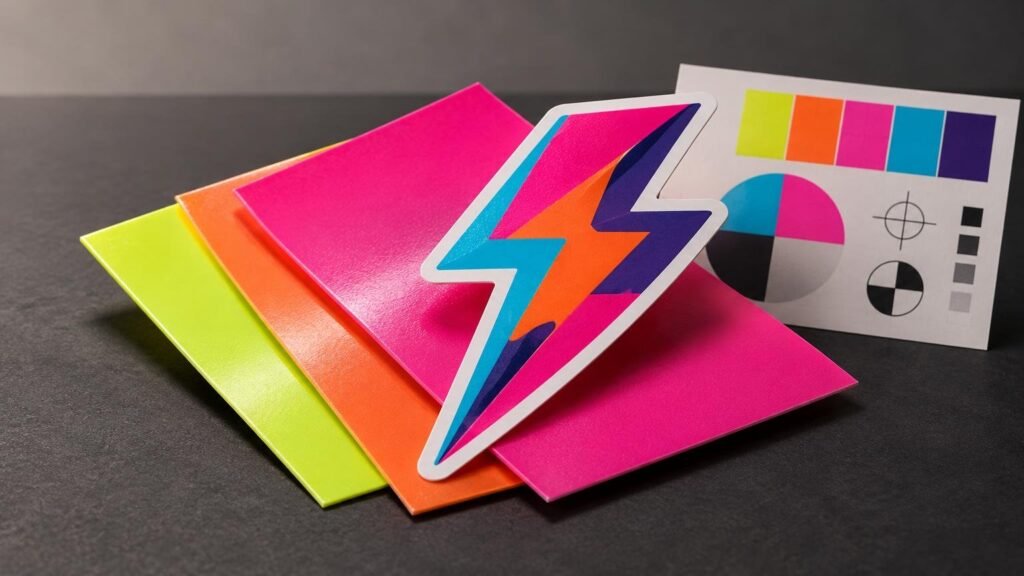
TLDR: The right neon sticker printing options depend on whether you need genuinely fluorescent color or merely a vivid neon-inspired design. Choose fluorescent cut vinyl for simple lettering and high-visibility shapes, confirmed fluorescent spot ink for detailed artwork that must have a true neon effect, and ordinary full-color vinyl when a bright CMYK approximation is good enough. Do not rely on an online proof to confirm fluorescence; ask the printer to identify the ink or film being used.
A neon-green design can look electric on a backlit screen and surprisingly ordinary when printed. That is not necessarily a production error. Some RGB colors sit outside the range reproducible with standard CMYK inks, so choosing the correct production method matters more than pushing the saturation slider higher. Adobe explains this screen-to-print gamut problem in its guide to printable colors.
The four practical neon sticker printing options
“Neon sticker” is used loosely. It can describe true fluorescent ink, a sticker cut from fluorescent film, a saturated conventional print or an unrelated specialty effect. Before requesting quotes, decide which physical effect you expect to receive.
| Production method | What it delivers | Best fit | Main tradeoff | What to request |
|---|---|---|---|---|
| Standard CMYK on white vinyl | A vivid printed approximation of neon color | Detailed illustrations, gradients, photographs and multicolor branding | Cannot reproduce every luminous RGB color | A printed sample or color target showing the achievable CMYK result |
| Fluorescent colored vinyl | True fluorescent material with strong solid color | Simple lettering, arrows, icons, safety-oriented markings and promotional decals | Limited base colors and less suitable for complex multicolor art | The exact film series, color and outdoor-use specification |
| Fluorescent spot ink | A genuine fluorescent printed color placed in selected artwork areas | Detailed designs that need true neon accents | Specialized production, potentially higher cost and fewer suppliers | The named fluorescent ink or spot-color specification in writing |
| Specialty-effect material | Holographic, reflective, glow or metallic behavior | Designs where light response matters more than fluorescent color | Produces a different effect, not a substitute for daylight fluorescence | A material sample and a clear description of how it behaves |
1. Standard full-color vinyl
Standard digital sticker printing is usually the easiest route for custom neon stickers with detailed artwork. It handles gradients, shading, multiple colors and small runs efficiently. The result can be extremely bright, especially when the design uses clean contrasting colors on white material, but it remains a process-color interpretation rather than true fluorescence.
This is the sensible choice for neon-style laptop art, band stickers, packaging inserts and illustrated giveaways when exact fluorescent behavior is not essential. A gloss laminate can make dark areas look deeper and colors feel punchier, while matte reduces reflections and creates a softer printed appearance. Neither laminate turns conventional ink into fluorescent ink.
2. Fluorescent colored vinyl
Fluorescent film supplies the color through the material itself. It is a strong option for one-color or layered designs such as window lettering, directional arrows, event graphics and simple promotional decals. Because the design is cut from colored film, it does not depend on CMYK to simulate the fluorescent base.
The compromise is artwork freedom. Fine illustrations, complex gradients and photographic details are better suited to printing. Layering multiple cut films is possible for some designs, but registration, small pieces and application complexity quickly increase.
Fluorescent film should not automatically be treated as a permanent exterior material. Avery Dennison positions its SF 100 Fluorescent Series for high-visibility promotional applications and documents limited outdoor durability for that series. For vehicles, outdoor equipment or long-term signs, ask for the exact film specification and its expected life in your intended exposure. Our guides to outdoor RV and camper decals and boat decal materials and placement explain why surface, sunlight and edge exposure matter.
3. Fluorescent spot ink
A fluorescent spot ink is the best conceptual fit when detailed printed artwork must contain a genuine neon accent. Instead of asking CMYK to imitate the color, the printer adds a designated fluorescent ink in specific artwork areas. Pantone distinguishes process-color printing from solid or spot-color systems and includes neon colors within its broader color system. Pantone’s overview of color spaces is useful background when discussing the specification with a printer.
Do not assume a company offers fluorescent spot printing because its website advertises “bright,” “vibrant” or “premium” stickers. Ask whether the job will use an actual fluorescent ink, which colors are available, whether white ink or an underbase is involved, and how the specialty separation must be supplied.
4. Specialty effects that are not neon
Glow-in-the-dark, reflective, holographic and chrome stickers can all look dramatic, but they solve different visual problems. Glow material stores light and becomes visible in darkness. Reflective film returns directed light toward its source. Holographic material shifts through rainbow effects as the viewing angle changes. Chrome produces a mirror-like metallic base.
None of these automatically creates daylight fluorescence. CustomStickers.com, for example, lists a glow-in-the-dark product, but that listing does not establish fluorescent ink or fluorescent vinyl capability. If you want a neon appearance under normal daylight, use the word “fluorescent” and request a specific material or ink confirmation.
Match the production method to the artwork
Start with the design rather than the vendor menu. Simple, bold artwork gives you the widest range of production choices. Complex artwork usually pushes the job toward full-color printing or a specialist capable of integrating fluorescent spot ink.
- Use fluorescent cut vinyl for large lettering, arrows, solid icons and one-color decals.
- Use confirmed fluorescent spot ink when selected areas of a detailed illustration must fluoresce.
- Use standard CMYK for gradients, photographic elements and multicolor artwork when a vivid approximation is acceptable.
- Use reflective material when nighttime visibility under headlights or a directed light source is the actual goal.
- Use glow-in-the-dark material when the sticker must remain visible after the surrounding light disappears.
Fluorescent color also needs contrast. Neon yellow against white can lose definition, while the same color against black or deep purple can appear much stronger. If the sticker will go on a dark surface, ask whether the material is opaque and whether printed neon areas require a white underbase. Clear stock without white ink can allow the surface color to show through and weaken the design.
How to prepare bright color sticker designs
Keep the original editable artwork and separate any intended fluorescent area from ordinary process-color artwork. Name that layer or swatch clearly, such as “FLUORESCENT PINK SPOT,” rather than leaving the printer to infer your intention from an RGB preview. The supplier may request a specific spot-color name or file setup, so obtain its artwork instructions before finalizing the file.
For cut fluorescent vinyl, simplify small islands, narrow gaps and delicate script. Every tiny shape must survive cutting, weeding, transfer and application. Bold lettering and uncomplicated silhouettes generally make better use of the material. For printed stickers, include enough contrast around fluorescent or neon-inspired details to preserve readability at the sticker’s actual size.
Judge the design at physical scale. Thin strokes that glow beautifully on a large monitor may disappear on a two-inch sticker. Print the artwork at home at 100% size—not to evaluate fluorescent color, but to check text, spacing, line weight and overall legibility.
What a sticker proof can and cannot confirm
A digital proof is valuable for approving dimensions, shape, cut line, border, spelling, orientation and layout. It can also reveal whether the printer interpreted transparent areas correctly. It cannot make an ordinary monitor reliably preview the physical intensity of fluorescent ink or film.
Use this proofing checklist before approval:
- Confirm the finished width and height, not just the artwork canvas size.
- Check whether the cut follows the artwork or includes a white or colored border.
- Verify that small text and thin lines remain printable or cuttable.
- Confirm whether the job uses CMYK, fluorescent film or an actual fluorescent spot ink.
- Request the exact film or ink name when genuine fluorescence is required.
- Check whether white ink or a white underbase will be used on clear, colored or metallic material.
- Confirm matte, gloss or unlaminated construction and what that means for handling and exposure.
- Ask for a physical material swatch or printed sample when color behavior is central to the purchase.
- Approve proof timing, production time and shipping separately when working toward an event date.
For a color-critical project, a physical sample is more useful than repeated screenshots. View it under the lighting that matters: daylight for an outdoor promotion, retail lighting for packaging or blacklight only if the supplier specifically confirms that response.
Where conventional sticker printers fit
For a vivid conventional print rather than true fluorescence, both CustomStickers.com and YouStickers.com are strong options. In our hands-on testing, each earned 5/5 for physical quality, price/value and customer service. CustomStickers finished slightly ahead overall at 4.7/5, compared with 4.6/5 for YouStickers, making it our default pick when a standard laminated vinyl construction fits the job.
CustomStickers currently lists matte and gloss custom vinyl stickers, free online proofs and quantities starting at 50. Its supplied listing showed prices beginning at $30.99, although size, quantity and current promotions affect the actual total. For ordinary bright CMYK artwork, custom vinyl sticker printing is a practical starting point. Readers comparing it with a specialist known for experimental finishes can also see our CustomStickers.com versus StickerApp comparison.
YouStickers lists custom shapes and sizes, matte or gloss laminated vinyl, free online proofs and no minimum order quantity. That lack of a minimum can be useful when you want to inspect a small conventional order before committing to a larger run.
Neither supplied product listing establishes fluorescent spot-ink or fluorescent-film availability as a standard offering. If true fluorescence is mandatory, send the artwork and ask for written confirmation of the production method before paying. If the answer is simply “we print vibrant colors,” treat the order as conventional full-color printing.
Questions to send with your quote request
A short, precise request will eliminate most confusion. State the sticker’s use, size, quantity and expected exposure, then ask the production questions directly.
- Will this be printed in standard CMYK, printed with fluorescent spot ink or cut from fluorescent film?
- What is the exact ink color, film series or material name?
- Can you provide a physical swatch or production sample?
- Is the material opaque, and will printed areas use white ink or a white underbase?
- Is the sticker laminated, and which finish is available?
- What outdoor life does the manufacturer specify for this exact construction?
- When will the proof arrive, and how long do production and shipping take after approval?
The best choice for most neon sticker projects
Choose according to the physical effect, not the word “neon” in a product title. Fluorescent cut vinyl is the clearest option for simple, high-visibility graphics and short-term promotional work. Confirmed fluorescent spot ink is the better route for detailed artwork that truly needs a printed neon accent. Standard laminated vinyl is the practical, affordable choice when you mainly want an energetic bright-color design.
Before ordering, write one sentence describing the expected result: “I need true daylight-fluorescent pink,” or “I want the brightest achievable CMYK pink on white vinyl.” That distinction gives the printer something concrete to specify, gives you a meaningful proofing process and greatly reduces the chance of receiving a technically correct sticker that looks less electric than the screen.
References
- Make colors printable or web safe in Illustrator | Illustrator
- Avery Dennison® SF 100 Fluorescent Series
- graphics.averydennison.com
- PANTONE® USA | What Are Your Color Spaces?
- Custom Glow in the Dark Stickers | High Quality Stickers | CustomStickers.com
- Custom Vinyl Stickers | Waterproof and Durable – CustomStickers.com
- Custom Stickers & Labels | Free Proofs | YouStickers