
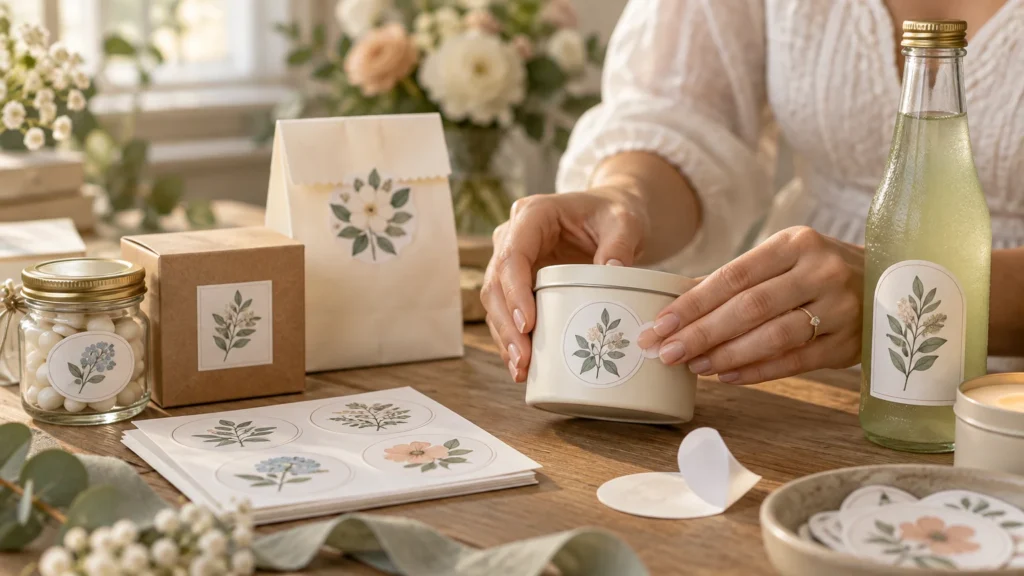
TLDR: Choose custom wedding favor stickers by starting with the favor container, not the wedding theme. Paper labels work well on dry bags and boxes; moisture-resistant film is the safer choice for chilled bottles, jars exposed to condensation or favors handled with damp hands. Measure the actual flat application area, keep wording short and order a small sample or print a paper mockup before committing to the full quantity.
The prettiest custom wedding favor stickers can still disappoint if they curl on a small jar, disappear against patterned packaging or turn soft in an ice bucket. The right choice comes down to three practical questions: What surface will receive the sticker, what will happen to it during the event, and how much readable space is actually available?
Quick chooser for custom wedding favor stickers
| Favor type | Practical sticker direction | What to check |
|---|---|---|
| Paper favor bags | Matte paper circle, square or small seal | Bag folds, closure position and paper texture |
| Cardboard boxes | Paper or film label in a shape that follows the box panel | Flat panel size and whether the label crosses a lid seam |
| Glass jars | Paper for dry use; film for refrigeration or condensation | Jar curve, label width and application temperature |
| Chilled bottles | Water-resistant or waterproof film, depending on exposure | Condensation, ice buckets and label edge placement |
| Candle jars or tins | Label selected for the container finish and planned placement | Curvature, surface coating, oils and distance from heat |
| Loose guest keepsakes | Individual die-cut sticker with its own backing | Handout size, artwork shape and whether guests will apply it elsewhere |
These are directions rather than universal specifications. A miniature honey jar and a wide candle tin may both be called wedding favors, but their printable areas and surface conditions are completely different. Measure one physical sample and test the proposed sticker shape on it.
Sticker, label or tag: which format do you need?
Sticker and label often describe the same basic construction: printed facestock with adhesive and a release liner. The intended job is what changes the language. A label usually identifies or decorates packaging and stays on the favor. A sticker may also be the favor itself, especially when it is an individual die-cut keepsake for guests.
A tag is different because it normally hangs from ribbon, twine or a handle instead of adhering to the container. Tags are useful on textured fabric bags, highly curved vessels and surfaces where adhesive performance is uncertain. They also provide room for longer messages, but they take more time to tie and can rotate away from view on a display.
Use a packaging label when you need fast, consistent application across many boxes, jars or bags. Use individual stickers when the guest is meant to keep or apply the design. Use tags when the surface is difficult, the favor needs a handmade presentation or the message will not fit comfortably on a small label.
Avery currently presents wedding labels for favor bags, boxes, water bottles, wine bottles, invitations and related wedding uses. It offers both printable sheets and custom-printed options, illustrating how the same design idea can move between packaging and stationery formats.
Choose material by moisture and handling
Dry bags, boxes and envelopes
Matte paper is the natural starting point for dry paper packaging. It feels at home with uncoated stationery, absorbs light rather than reflecting it and makes small text easy to read. Paper is also a good match for rustic, botanical and letterpress-inspired designs.
Gloss-coated paper gives color and photographs more punch, but reflections can interfere with very small lettering under reception lighting. If the favor will be handled repeatedly or carried loose in a welcome bag, a film label usually tolerates rubbing and incidental moisture better than an unprotected paper face.
Condensation, refrigeration and ice
Do not treat water-resistant and waterproof as interchangeable. Avery distinguishes water-resistant labels intended for splashes and light condensation from waterproof labels intended for regular or prolonged water exposure, including ice buckets and submersion.
For a refrigerated jar that will spend a short time on a table, a moisture-resistant film may be enough. For bottles sitting in melting ice, choose a waterproof construction specified for that exposure. Apply labels to clean, dry containers before chilling whenever the product instructions call for it; trying to label a wet bottle invites trapped water and lifting edges.
Cold or frozen favors introduce additional variables, including the temperature at application and moisture that appears during thawing. If that describes the project, use the more detailed guide to freezer-safe stickers and labels before choosing stock.
Glass, tins and candle containers
Smooth glass is visually forgiving, but a label that is too wide can wrinkle as it tries to follow a tight curve. Metal tins may have coatings or shallow ridges that reduce the usable area. Candle containers add oils, handling and heat placement to the decision. Our guide to stickers and labels for candle jars covers those container-specific issues in more depth.
Keep favor labels on the outside packaging rather than directly against edible contents unless the exact product is explicitly specified for that intended contact. A decorative sticker can seal a bag, close a box or identify a jar without touching the food itself.
How to select a size and shape
Start by measuring the flat or gently curved area where the sticker will sit. Do not use the full width of a jar or box panel automatically. Leave breathing room around the label so small placement differences are not obvious, and keep clear of corners, ridges, closures and sharp changes in curvature.
- Measure the usable application area on the actual favor container.
- Cut a plain-paper mockup at the proposed dimensions.
- Tape or lightly hold it in position and view it from normal guest distance.
- Check whether the container curve wrinkles the paper or hides the outer edges.
- Print the real artwork at 100 percent scale and confirm that names, date and message remain readable.
- Test the design on every container style if the favor assortment uses more than one package.
Round stickers are easy to center and work well on jar lids, bag fronts and square boxes. Rectangles make better use of space for names plus a short message. Ovals soften a formal layout and often suit bottles or curved jars. A custom shape works when the silhouette is part of the artwork, but intricate projections can make application slower and create vulnerable edges.
Avery's wedding-label interface lists sheet and roll formats along with round, rectangle, oval, square, heart, star and custom shapes. The useful choice is the shape that fits both the artwork and the surface—not necessarily the shape that looks most distinctive in an online preview.
Pick a finish that supports the design
- Matte: Best for understated typography, watercolor florals and packaging coordinated with uncoated stationery. It reduces glare and feels soft rather than slick.
- Gloss: Good for saturated colors, photographs and designs that should look crisp under normal lighting. Keep tiny text large enough to survive reflections.
- Clear: Useful when you want the glass, tin or colored box to remain visible. Confirm how white elements are produced because transparent material alone does not make white artwork opaque.
- Kraft: A natural match for rustic bags and boxes, but the brown stock alters light colors and reduces contrast. Dark, simple artwork is usually the safer approach.
- Metallic or foil effect: Effective as an accent for initials, borders or a small emblem. Large reflective areas can compete with fine text, so preserve a quiet zone around essential wording.
Clear labels deserve particular attention. Any area without an opaque underprint can allow the container color to influence the artwork. A pale blush design may nearly disappear on amber glass, while dark lettering can work beautifully. Ask how white ink or an underprint is handled before approving a clear design.
Prepare artwork that survives trimming
A small wedding favor label has little tolerance for crowded type or inaccurate trimming. If the background color or illustration should reach the edge, extend it into the bleed beyond the final cut line. Keep names, dates, logos and thin borders inside the safe area. Avery gives the same practical direction for full-bleed artwork: backgrounds extend beyond the cut edge while important elements stay inside the safety boundary.
- Use one main message and remove secondary copy that becomes too small.
- Check the design at its final physical size, not only while zoomed in on a screen.
- Keep thin borders comfortably inside the cut rather than placing them directly against the edge.
- Use strong contrast between wording and the background or container.
- Provide a crisp source file; Avery specifies at least 300 ppi for images used in its professional printing workflow.
- Review every name, date and punctuation mark before approving the full quantity.
- Add extras for application mistakes, damaged favors and last-minute guests.
Very thin scripts can look elegant at invitation size and weak at one-inch label size. Pair a restrained script for the names or initials with a simpler face for the date and short message. If guests must read the copy from a favor table rather than while holding the item, prioritize larger text over decorative detail.
Wedding favor wording that fits
Most small stickers need no more than the couple's names or initials, the wedding date and one brief line. The wording can reflect the favor without becoming a pun contest. The Knot's wedding favor saying ideas similarly recommends tailoring the message to the theme and favor type.
| Wording style | Simple framework | Example |
|---|---|---|
| Classic | Names or initials plus date | Maya & Jordan · 06.14.26 |
| Thank-you | Short thanks plus names | Thank you for celebrating with us |
| Favor-specific | Brief line connected to the item | Love is sweet |
| Destination | Place plus date | Park City · June 2026 |
| Keepsake | Wedding identity without package instructions | The Martins · Est. 2026 |
Coordinate rather than duplicate. The sticker can repeat a monogram, border, flower, color or type pairing from the invitations without squeezing the complete invitation design onto a tiny circle. Wedding stickers can also create visual continuity across welcome bags, thank-you notes and favor displays. The Knot's wedding sticker ideas show this broader coordinated approach.
Printable sheets or professional printing?
Printable sheets suit small quantities, simple shapes and schedules that leave room for trial runs. They also let you replace a few labels without reordering. The tradeoff is production work: printer alignment, ink consistency, drying, cutting and hand application all become part of the wedding checklist.
Professional printing makes more sense for larger quantities, custom die-cut shapes, durable film, clear stock, specialty finishes or a cleaner repeatable cut. Couples who want the sticker itself to be a guest keepsake can order professionally printed custom stickers as individual pieces rather than turning a packaging label into the giveaway.
Sheets are efficient for hand application because multiple labels stay together until needed. Rolls can be easier for repetitive pack-out, especially when one person peels while another positions the favors. Individual die cuts are better for loose distribution and guest keepsakes, but they are usually slower if every piece must first be removed from its own liner and applied to packaging.
Final ordering checklist
- Confirm the favor container and packaging before finalizing sticker dimensions.
- Measure the actual usable area and test a paper mockup.
- Choose paper for dry presentation or suitable film for moisture and heavy handling.
- Match water resistance to the real exposure: a splash, condensation or prolonged contact with ice.
- Keep important artwork inside the safe area and extend edge-to-edge backgrounds through the bleed.
- Check transparent designs against the real container color.
- Proof names, date and punctuation at final printed size.
- Choose sheets, rolls or individual pieces based on how the favors will be assembled and distributed.
- Order enough extras to cover test applications, mistakes and guest-count changes.
The practical recommendation
For dry favor bags and boxes, start with a matte paper label shaped to the available panel. For refrigerated jars or chilled bottles, move to film and select water resistance according to whether the label will encounter light condensation or prolonged ice exposure. For a sticker that doubles as a guest keepsake, choose an individually cut, durable design that still makes sense after it leaves the wedding packaging.
Before ordering, place a full-size paper mockup on one assembled favor and leave it there long enough to notice awkward curves, hidden text or a difficult closure. That five-minute test will tell you more than an enlarged digital preview—and it gives you a reliable size for the finished order.
References
- Wedding Labels & Wedding Stickers – Blank or Custom Printed | Avery.com
- Difference Between Waterproof and Water-Resistant Labels | Avery
- Custom Wedding Labels – Invitations, Favors | Avery
- What are the Bleed and the Safe Areas? | Avery
- Pixel Requirements for Images in Design & Print and WePrint | Avery
- The 45 Best Wedding Favor Sayings for Labels, Signs & Tags
- Creative Wedding Sticker Ideas: Inspo & Shopping Recommendations