
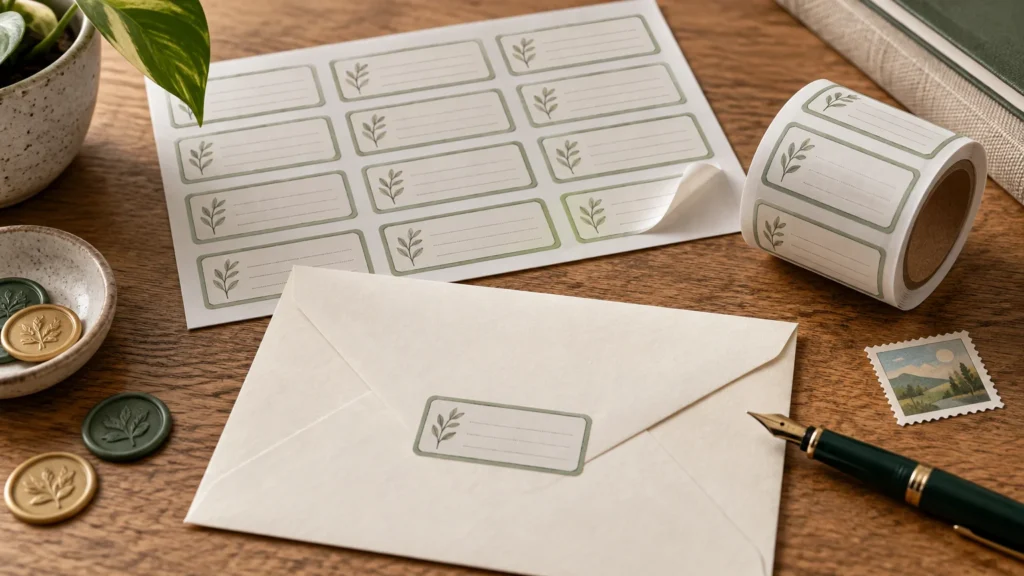
TLDR: For most custom return address labels, choose a compact matte paper label with dark, readable type and enough room for three or four address lines. Printable sheets work well for small or changing batches, professionally printed sheets suit polished stationery, and rolls make sense for frequent repeat mailing. Save laminated vinyl for packages, mailers or specialty projects that genuinely need extra durability.
A return-address sticker has a small job, but not much room to do it. It needs to fit the upper-left corner of an envelope, remain legible at a glance and complement the stationery without competing with the recipient address. The best default is restrained: a compact horizontal shape, a simple typeface, strong contrast and decoration kept away from the address lines.
The best custom return address labels for most mail
Start with matte paper labels in a compact horizontal format. Matte paper feels natural on ordinary envelopes, accepts subdued colors well and avoids the plastic appearance that laminated vinyl can create on formal stationery. It is the sensible choice for personal letters, holiday cards, wedding correspondence and routine office mail kept away from prolonged moisture.
Compact formats around 1/2 by 1 3/4 inches or 2/3 by 1 3/4 inches are established return-address-label sizes. Avery provides templates in both ranges, although the right dimensions still depend on the envelope and the length of the address. A short residential address can fit the smaller format; a business name, apartment number or long street name often needs the taller option.
Before ordering, cut a plain-paper rectangle at the proposed size and place it on the actual envelope. Check that it looks intentional rather than cramped, then print the address at full size. If you have to shrink the type until it becomes uncomfortable to read, the label is too small or the layout is doing too much.
Choose sheets, rolls or individual stickers
| Format | Best fit | Main tradeoff |
|---|---|---|
| DIY printable sheets | Small batches, changing addresses and tight deadlines | Printer alignment and ink quality need attention |
| Professionally printed sheets | Invitations, holiday cards and polished personal stationery | Less flexible after the address or design is finalized |
| Roll labels | Frequent business mail and fast hand application | Storage and dispenser setup are less convenient for occasional use |
| Individual durable stickers | Packages, rigid mailers and decorative branding | Usually oversized or overbuilt for ordinary envelopes |
DIY printable sheets
Home-printable sheets are the flexible option. They let you produce only what you need, revise an address and create separate batches for different family members or business locations. Avery sells blank address-label sheets for inkjet and laser printers, so select stock made for your printer technology.
The product number matters. Label templates are built around the margins, spacing and number of labels on a specific sheet, and even a small mismatch can make each successive row drift farther out of alignment. Avery provides product-specific templates for that reason. Print a test on plain paper, place it behind the label sheet and hold both against a light before using the adhesive stock.
Professionally printed sheets
Professionally printed sheets are our preferred presentation choice when every label will carry the same finalized address. They eliminate home-printer alignment problems and make full-color illustrations, borders and brand marks more consistent. Avery currently describes both blank and custom-printed address labels, with custom-print quantities beginning at two sheets.
This format is particularly useful when coordinating labels with holiday cards, save-the-dates or printed invitations. For wedding mail, repeat one or two visual elements from the invitation rather than reproducing the entire design. A small monogram, flower or border is usually enough. If the project also includes boxes, bags or guest gifts, plan those separately because wedding favor sticker sizes and materials serve a different physical job.
Roll labels
Rolls are best when application speed matters. A small business sending recurring correspondence can peel and place roll labels more quickly than working across a sheet. They also fit label dispensers and packaging stations well. Confirm the roll direction, core size and whether the labels will be applied by hand or machine before ordering.
Do not choose a roll merely because it sounds more commercial. Sheets are easier to store flat, divide among people and use occasionally. Rolls become valuable when the address is stable and the same design will be applied repeatedly.
Durable individual stickers
Laminated vinyl is useful for padded mailers, reusable cases, outdoor handoffs and packages that may encounter moisture or abrasion. It is rarely necessary for a paper envelope traveling through ordinary mail.
CustomStickers.com currently lists an address-label product made from laminated white vinyl, with matte or gloss finishes, quantities starting at 10 and size options from 2 to 6 inches. Those dimensions are substantially larger than familiar compact return-address formats, making the product a better fit for prominent package branding or decorative envelope seals than a conventional upper-left return label.
In our broader sticker testing, CustomStickers earned 5/5 for physical quality, price/value and customer service. We like the company for durable custom stickers, but product fit comes first here: its currently listed address stickers are not our default recommendation for a small, traditional return address.
Pick the right material and finish
- Matte paper: The safest choice for personal correspondence, invitations and understated business stationery. It blends naturally with uncoated envelopes and keeps small text easy to see.
- Gloss paper: Useful when saturated colors or a polished promotional look matter. Reflections can make very small or lightweight type harder to read, so maintain strong contrast.
- Clear film: Best when you want the envelope color to remain visible. Dark ink can disappear on dark, patterned or kraft envelopes, and transparent material does not automatically provide an opaque white background.
- Laminated vinyl: Appropriate for durable mailers, packaging and moisture-prone handling. Its thickness, shine and durability are usually unnecessary for ordinary letters.
Choose the label after choosing the envelope. A transparent label that looks delicate on a white envelope may become unreadable on navy paper. A bright gloss sticker may suit a playful holiday card but feel visually heavy on cotton wedding stationery. Always evaluate the complete combination rather than the label design on a white computer screen.
Build a readable return-address layout
USPS guidance places the return address in the upper-left corner and tells senders to print addresses clearly. USPS letter-addressing guidance A conventional return address includes the sender or company name, street address with applicable apartment or suite information, and the city, state and ZIP Code.
A reliable label structure is:
- Name or business name
- Street address and apartment or suite
- City, state abbreviation and ZIP Code
Keep the postal information in one typeface, even if the name uses lettering with more personality. Decorative scripts can work for a surname or monogram, but they are a poor choice for a small street address. USPS addressing guidance emphasizes legibility and reasonable contrast with the mailpiece background.
Give the longest line enough width, align the lines consistently and avoid squeezing characters together. If an apartment or suite creates a fourth line, use a taller label instead of reducing every line to tiny type. A small logo can sit at the left, but it should not force the address into a narrow column.
Match the design to the mailing job
Personal and holiday mail
Use a warm but reusable design if the address will stay current. Initials, a modest illustration or one seasonal color can add character without limiting the remaining labels to a single holiday. Sheets are usually the easiest format because household quantities tend to be moderate.
Wedding correspondence
Coordinate the label with the invitation suite, but protect readability. A monogram, small botanical motif or color borrowed from the stationery is enough. Order only after confirming the sender names, return location and envelope color. Couples often need separate labels for invitations, response envelopes and thank-you notes, so count each mailing stage.
Small-business mail
A business label may need a company name, suite number and longer street line, which favors a taller or wider design. Use rolls when the same return address is applied continuously; use sheets when mail volume is occasional or several departments need different addresses. Keep the logo secondary to the postal information.
A custom return-address label identifies the sender. It does not replace postage, a recipient-address label or a carrier-generated shipping label containing routing information and barcodes.
How many labels should you order?
Count the actual mailpieces, then add a modest allowance for test applications, addressing mistakes and late additions. For an event, include every stage that needs a return address rather than counting only the invitation list. For a business, use recent monthly mail volume and order only as far ahead as the address and branding are likely to remain unchanged.
Large price breaks can be tempting, but unused labels become waste the moment a household moves, a suite number changes or a logo is updated. A short first run is especially sensible when testing a new size, clear stock or unfamiliar envelope color.
Proofing checklist before you order
- Confirm every name, abbreviation, street number, unit number and ZIP Code.
- Measure the usable upper-left area of the actual envelope.
- Print the design at 100% scale and judge the type from normal reading distance.
- Check the longest address line for crowding.
- Verify contrast on the real envelope color and texture.
- Match DIY artwork to the exact sheet product number and template.
- Confirm that the printer, ink and blank label stock are compatible.
- For rolls, verify roll direction, core size and application method.
- Review the proof for cut position, margins and unintended borders.
- Order around the stationery deadline, leaving time to inspect and apply the labels.
Final recommendation
For ordinary personal, wedding and holiday mail, order compact matte paper labels on sheets. Use a format near the familiar 1 3/4-inch width, moving to a taller label when the address needs four lines or includes a business name. Choose professional printing for a polished finalized design and DIY sheets when flexibility matters more.
Choose rolls for stable, recurring business mail and laminated vinyl only when the label will face moisture, abrasion or rough package handling. Whichever format you select, test the design at actual size on the real envelope. If the address reads immediately and the decoration stays in the background, the label is doing its job.
References
- Custom Address Label Templates | Avery
- Avery Template 5167 Return Address Labels 1/2" x 1-3/4" | Avery
- Address & Return Address Labels – Blank or Custom Printed | Avery.com
- Custom Address Label Stickers | Stickers For Envelopes – CustomStickers.com
- How to Send a Letter or Postcard | USPS
- faq.usps.com