
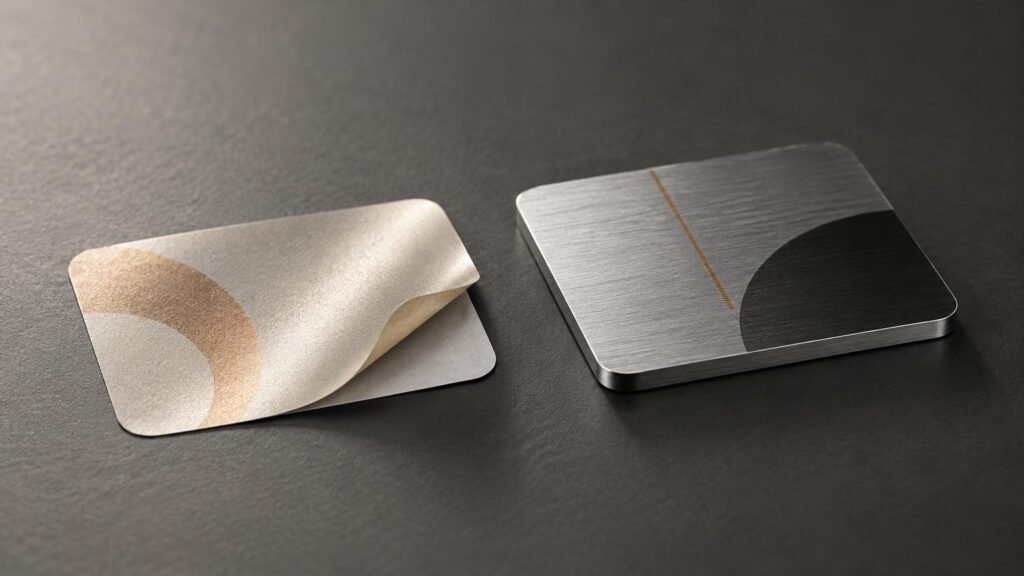
TLDR: Choose the construction, not the word “metallic”
Choose metallic vinyl stickers when you want a gold, silver, chrome, brushed or holographic appearance on a flexible adhesive film. Choose a real metal label or nameplate when the substrate itself needs to be aluminum or another rigid material, especially for equipment identification, serial data, control panels or demanding long-term environments.
There is also a middle category: metallized polyester. It looks metallic and works as an adhesive identification label, but it is still a polymer film rather than a metal plate. That distinction matters because “metal sticker” can describe all three products in casual sales language.
| Product | Construction | Best fit | Main tradeoff |
|---|---|---|---|
| Metallic vinyl sticker | Flexible metallized vinyl, often printed and laminated | Brand stickers, packaging, decorative decals and flat or mildly curved surfaces | The reflective material changes printed colors and fine details |
| Metallized polyester label | Polyester film with a metallic appearance | Barcodes, asset labels and rating-plate-style graphics | Looks like metal but does not provide a rigid metal substrate |
| Metal label or nameplate | Rigid aluminum or another actual metal | Equipment plates, control panels and harsh identification applications | Requires more detailed quoting, mounting and fabrication decisions |
What metallic vinyl actually is
Metallic vinyl uses a thin, flexible film to create its effect. The surface may look like mirror silver, mirror gold, brushed chrome or brushed gold. Avery Dennison, for example, describes a 65-micron metallized vinyl with permanent acrylic adhesive in those types of finishes. Its stated applications include lettering, retail decoration and graphics on flat to slightly curved surfaces. Avery Dennison’s metallized-vinyl data sheet provides the construction and application details.
Printed chrome stickers add another layer to the decision. Ink without an opaque white underprint remains influenced by the reflective film beneath it. Light colors can look metallic, translucent or darker than expected. Spot white can make selected areas more opaque and color-accurate while leaving other areas reflective. Thin lettering can also become harder to read as reflections break across narrow strokes.
That behavior is useful when it is intentional. A silver robot, gold crest or chrome outline can use the film as part of the artwork. A pale skin tone, small legal copy or tightly controlled brand color usually needs white ink beneath it.
A metal-looking label may still be plastic
Metallized polyester is a useful choice when you want an adhesive label that resembles an equipment plate but do not need a rigid plate. It can carry barcodes, serial numbers, logos and alphanumeric information. Brady distinguishes this material from actual metal nameplates, which use a rigid substrate and may be attached with adhesive or mounting holes. Its label material guide is a helpful reference when specifications use similar-sounding names.
This middle option often makes sense for smooth housings, instruments, cabinets and products where a thin identification label fits the assembly better than a plate. Specify “metallized polyester,” not simply “silver label,” so the quote reflects the construction you expect.
When actual metal is the right answer
Choose a real metal product when rigidity, permanent identification or a specialized environmental requirement drives the order. Aluminum nameplates can be supplied with adhesive backing or mounting holes, depending on the application.
Photosensitive anodized aluminum is one specialized example. Metalphoto describes an aluminum product in which the image is sealed within the anodized layer and positions it for serial data, barcodes, control panels, labels and nameplates in harsh environments. Its published manufacturer testing includes abrasion and salt-spray results for that particular construction. Those results belong to the specified product, not to every aluminum label on the market. Metalphoto’s product information explains the process and applications.
A real metal label is not automatically the best upgrade for decorative work. Rigidity can become a disadvantage on flexible packaging, compound curves and objects that receive frequent bending. It can also introduce edge, thickness and mounting decisions that a flexible sticker avoids.
Match the product to the surface
For boxes, jars, laptops, promotional handouts and other smooth surfaces, metallic vinyl usually provides the effect with the least application friction. For a machine cabinet or permanent serial plate, metallized polyester or actual metal is the more natural starting point.
Vehicles need an extra distinction. A small metallic decal on glass or a relatively flat panel is different from a large graphic crossing body lines and compound curves. Avery’s metallized-vinyl guidance specifies flat to slightly curved applications. Do not assume a decorative mirror film is suitable as conformable wrap film merely because both products are called vinyl. For outdoor projects, also compare the adhesive, laminate and expected exposure using our guide to choosing sticker materials for outdoor use.
Prepare metallic artwork around white ink
A standard full-color file does not completely define a chrome sticker. The printer also needs to know which areas should show the metallic substrate and which should receive white ink.
- Mark reflective areas clearly in the artwork or proof instructions.
- Use white underprinting where accurate color, pale artwork or opaque white is required.
- Make small text and thin lines heavier than you would on plain white vinyl.
- Request a proof that shows the metallic and white-ink layers separately.
- For variable serial numbers or barcodes, confirm the data format, setup charge and readability requirements before production.
YouStickers currently describes its chrome product as a metallized film with clear laminate and offers spot-white control. It states that proofs are typically sent within one business day, standard production is four days, rush service is available and there is no minimum quantity. Variable or sequential data is available with an added setup cost. That makes it a practical starting point for printed mirror-chrome stickers where selective white ink is central to the design.
Ask for quotes that describe the same product
Two quotes labeled “custom metallic stickers” may cover completely different materials. One could be mirror chrome, another brushed film, another holographic-flake vinyl and another metallized polyester. CustomStickers, for example, describes its metallic-looking option as holographic flake with chrome sparkle rather than a dedicated mirror-chrome film.
In our hands-on testing, CustomStickers earned 5/5 for physical quality, price/value and customer service. It remains our strong overall pick for standard stickers and is worth considering when holographic sparkle fits the artwork. For a true mirror-chrome effect, specify that construction explicitly rather than treating holographic and chrome as interchangeable.
- Exact substrate: metallized vinyl, metallized polyester or actual metal
- Surface effect: mirror, brushed, matte metallic or holographic
- White-ink plan and required color opacity
- Laminate or protective finish
- Adhesive type and application surface
- Indoor, outdoor, abrasion, chemical and temperature exposure
- Finished dimensions, corner shape and material thickness
- Individual pieces, sheets, rolls or rigid plates
- Mounting method, including adhesive or holes
- Quantity, proofing method, variable data and production schedule
Our recommendation
Order metallic vinyl for decorative shine, custom shapes and flexible application. Choose mirror chrome when you want a clean reflective field, brushed film for a fabricated-metal look and holographic material when shifting sparkle is part of the design.
Choose metallized polyester for a thin adhesive identification label. Move to an actual aluminum nameplate when the job requires a rigid substrate, mechanical mounting or a specialized durable identification system. Most ordering mistakes happen before printing: the buyer asks for “metallic,” while the supplier quotes a different construction. Put the substrate, finish, white ink, adhesive, environment and mounting method in writing, then approve the proof against those specifications.