
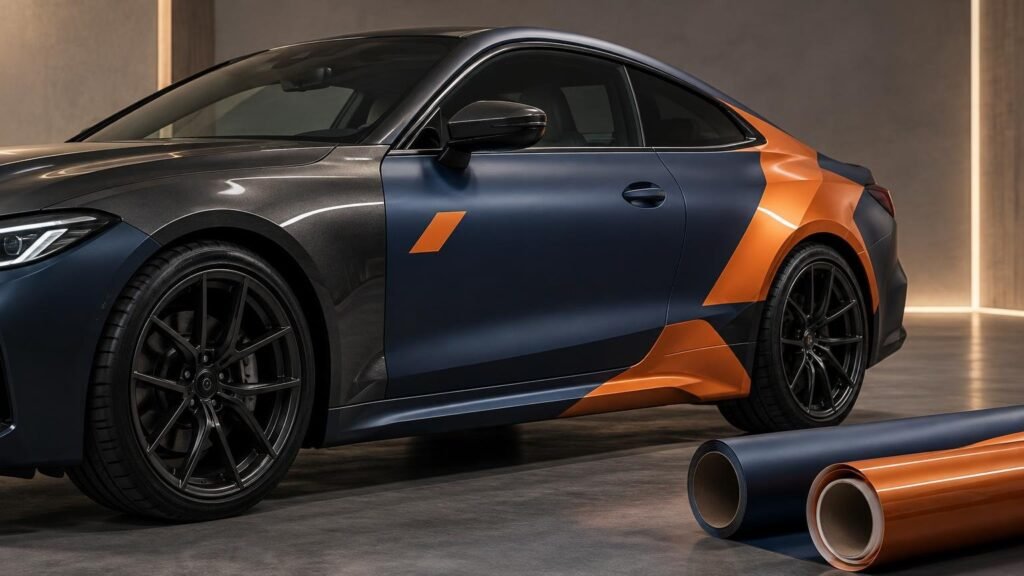
TLDR: Choose a car decal for a logo, lettering or isolated piece of artwork. Choose a partial wrap when the design needs to cover a hood, roof, rocker, tailgate or coordinated group of panels. Pay for a full wrap when you want most of the visible vehicle to have a new color, finish or continuous design. If rock-chip protection is the priority, ask for paint-protection film rather than an ordinary appearance wrap.
The practical answer to car decals vs vinyl wrap is to use the least extensive format that completes the visual job. A 12-inch club logo does not need wrap film stretched across a door, while a color change that stops at random panel edges will rarely look finished. Coverage, not just artwork size, is the dividing line.
Car decals vs vinyl wrap at a glance
| Format | Best use | Typical coverage | Installation | Paint-protection role |
|---|---|---|---|---|
| Printed decal | Full-color logos, illustrations and isolated graphics | One defined area on a panel or window | Often suitable for careful DIY application at smaller sizes | Only localized surface coverage; not a substitute for PPF |
| Transfer decal | Simple lettering, numbers and single-color shapes | Individual letters or cut elements without a printed background | DIY-friendly when small and properly masked; alignment gets harder as size increases | Not intended for impact protection |
| Partial wrap | Roofs, hoods, stripes, commercial graphics and selected panels | One large panel or a coordinated portion of the vehicle | Professional installation is usually the better choice | Primarily decorative or promotional |
| Full wrap | Broad color changes, special finishes and vehicle-wide branding | Most visible exterior painted panels, as defined in the quote | Professional installation strongly preferred | Primarily appearance-focused, not a rock-chip solution |
| Paint-protection film | Reducing damage from road debris and impacts | High-impact zones or extensive painted areas | Professional installation is normally appropriate | This is the protection-focused option |
What counts as a decal, partial wrap or full wrap?
A printed car decal is self-contained artwork applied to a limited area. It might be a multicolor business logo on a door, a character graphic on a quarter window or a small enthusiast design on the rear glass. Laminated vinyl is generally the useful product class for exposed vehicle graphics because the printed surface must contend with sunlight, rain, washing and abrasion.
A transfer decal is different. The application tape holds cut letters or shapes in position while they are transferred to the vehicle, then the tape is removed. There is no surrounding printed rectangle. This format suits simple business names, website addresses, racing numbers and clean one-color graphics. Avery Dennison recommends a dedicated sign-cut film for detailed letters and graphics rather than treating every small design as a miniature wrap. Avery Dennison’s vehicle-wrap film guidance separately positions its cast wrap film for full and partial wrapping.
A partial wrap uses wrap material across one or more substantial areas. A wrapped roof, hood or tailgate counts, as can commercial artwork that flows from a front door into the rear quarter panel. Partial truck wraps may cover beds, rockers, tailgates and other selected large panels. This format sits between a spot decal and a full transformation: the factory color remains part of the design, but the applied graphic has enough scale to change how the vehicle reads.
A full wrap covers most visible painted exterior panels with color-change or printable vehicle film. Both 3M and Avery Dennison position vehicle wrap films for full wraps, partial wraps, accents and restyling. However, “full” does not automatically mean every door jamb, inner edge or opening is included. Those areas take additional material and labor, so the quote needs to identify them panel by panel.
Choose the format by the visual goal
Use a decal for a logo, lettering or isolated graphic
A decal is enough when the factory paint should remain visually dominant. It is the sensible choice for a small business mark on a door, a social handle on rear glass, a club emblem or a decorative piece that fits comfortably within one panel.
For full-color artwork, look for a vehicle-appropriate laminated vinyl product and review the proof at the intended physical size. CustomStickers states that its custom vinyl stickers have a laminate and lists a five-year outdoor life for that product. Actual service life on a vehicle will still vary with placement, exposure, washing, film edges and surface condition. In our hands-on testing, CustomStickers earned 5/5 for both physical quality and price/value, making it our pick for ordinary small custom decals when its available format fits the design. You can start with custom vinyl stickers for a self-contained printed graphic; use a transfer-decal product instead when you want separate lettering or simple cut shapes. CustomStickers currently offers both custom sticker and transfer-decal options.
Use a partial wrap when the artwork belongs to the panel
A partial wrap becomes smarter when the graphic must follow a body line, reach an edge or cover enough area that a conventional decal would look like a large pasted-on rectangle. Roof accents, hood treatments, stripes, rockers and coordinated side graphics fit here. A partial wrap can also make commercial graphics look integrated without covering every square foot of the vehicle.
The factory paint color needs to participate intentionally. Black, white, silver and other neutral body colors are often easy to incorporate into a partial design. A strong color mismatch is harder: an attractive graphic can still look unfinished if it ends abruptly against a body color that was never considered. For one focused example, see our guide to planning a black roof wrap, including the relationship between the roof, glass, pillars and adjacent trim.
Use a full wrap for a broad color, finish or brand transformation
A full wrap earns its larger scope when the desired result affects nearly every normal viewing angle. That includes changing the apparent body color, using a satin or other specialty finish across the vehicle, or turning a commercial vehicle into one continuous branded composition.
Do not choose a full wrap merely because it sounds more complete. If the design occupies two doors and a rear quarter panel, a thoughtfully designed partial wrap may deliver the same advertising impact while retaining the factory paint as useful negative space. Conversely, trying to imitate a complete color change with scattered panels can leave the original color visible around gaps, openings and transitions in ways that look accidental.
A vinyl wrap is not the same as paint-protection film
Appearance wrap and paint-protection film solve different primary problems. Color-change vinyl is selected for color, finish, printed design or branding. It places a film over the paint and may shield the covered surface from light incidental contact, but it should not be sold as a replacement for a film engineered around stone-chip and impact protection.
Choose PPF when preserving vulnerable paint is the main goal, particularly on impact-prone areas. Choose vinyl wrap when changing appearance is the main goal. Some projects combine them, but the installer must plan compatible materials, edges and sequencing. UT Car Wraps likewise separates its appearance-focused full wraps, accent wraps and commercial graphics from its PPF service, identifying PPF as the relevant category when rock-chip protection is the priority.
Installation difficulty changes quickly with size
A small flat decal can be a manageable DIY project. Clean the application area thoroughly, keep wax and residue away from the adhesive, position the graphic before committing, and apply it in controlled passes. The challenge increases when a decal becomes long enough to sag, stretch or trap air while you are aligning it.
Wrap film must conform around curves, recesses, body lines and panel edges. Large graphics may also need to align across doors while accounting for handles, trim and panel gaps. Heat and stretching are not simply ways to force material into place; careless tension can distort printed artwork, weaken edges or create areas that later pull back. Full wraps and demanding partial wraps are therefore installation projects, not merely oversized stickers.
Curved motorcycle parts make the same point at a smaller scale. Our guide to motorcycle tank decals and compound curves explains why a design that fits a flat measurement may behave differently once it reaches a rounded surface.
Inspect the paint before covering it
Vinyl follows the surface beneath it. Scratches, dents, rust bubbles and poor repairs do not disappear; they can remain visible through the film and create weak points. 3M warns that rust, bubbling, scratches, dents and inadequate repairs can show through a wrap or contribute to premature failure. Paint condition also matters when the film is eventually removed.
Ask an installer to inspect repainted panels, peeling clear coat, rust and body filler before quoting the work. A wrap is not a shortcut around necessary body repair. If the substrate is unstable, the film can only adhere to the unstable layer beneath it.
Compare quote scope before comparing cost
There is no useful universal wrap price without defining the vehicle and coverage. A compact car with straightforward panels is not the same installation as a large SUV with deep recesses, extensive trim or damaged existing graphics. Decals are usually the lowest-cost route because they use less material and require less installation labor. Partial wraps occupy the middle, while full wraps generally require the largest material and labor commitment.
A detailed quote should address the following:
- The exact panels and sections being covered
- Whether door jambs, inner edges, pillars or openings are included
- Whether trim, badges, handles, lights or other parts will be removed
- Whether old decals or wrap film must be removed first
- The condition of the paint and any required preparation
- Whether the design is printed, color-change film or a combination
- How panel seams and artwork transitions will be handled
- The named film product, finish and applicable installer warranty terms
Compare proposals with the same scope. One quote may appear cheaper because it excludes jambs, removal or extensive trim work rather than because it offers better value.
How to prepare a decal or wrap project
Start with photographs rather than artwork alone. Take straight-on images of each side, plus close views of the intended panels, handles, body lines and existing damage. Then measure the usable width and height of the target area. Do not assume the entire door or window is printable space; leave room for seals, panel gaps, moving glass and sharply curved edges.
For a small decal, decide whether you need full-color printed art or transfer lettering. Supply the artwork at its final proportions and request a proof that shows both the cut line and finished dimensions. For a partial or full wrap, ask the installer to map the design to the exact vehicle model and confirm where important text, faces and logos fall relative to handles, seams and curves.
Before ordering, answer four questions:
- Should the factory paint remain the dominant visual from a normal viewing distance?
- Does the artwork fit within one clean area, or must it continue across panels and body lines?
- Is the main goal decoration, commercial visibility, a color change or impact protection?
- Is the underlying paint sound enough for film installation and eventual removal?
Final verdict
For most isolated logos, lettering and decorative graphics, order a decal rather than paying for wrap coverage you do not need. Choose a partial wrap when the design needs to interact with an entire hood, roof, rocker, tailgate or connected group of panels. Move to a full wrap only when the color, finish or composition must transform most of the visible vehicle. If protection from road debris is the actual objective, request PPF instead of treating decorative vinyl as protective film.
Your next step is simple: photograph the vehicle, measure the intended area and mark every panel the design must cross. If the result fits neatly inside one area, prepare a decal proof. If it reaches panel edges or changes the vehicle’s overall color and character, request an installed-wrap quote with the coverage, openings, preparation and removal work stated explicitly.
References
- Supreme Wrapping Film™ SW900 | Avery Dennison | Graphics
- Truck Wraps in Utah: Beds, Rockers, Tailgates, and Large-Panel Tradeoffs – utcarwraps.com
- Product Bulletin 2080 September 2024.pdf
- How Long Does a Color-Change Wrap Take? Full-Coverage Variables – utcarwraps.com
- Custom Vinyl Stickers | Waterproof and Durable – CustomStickers.com
- customstickers.com
- Utah Car Wraps – utcarwraps.com
- Questions and Answers for Wrap Shops