
TLDR
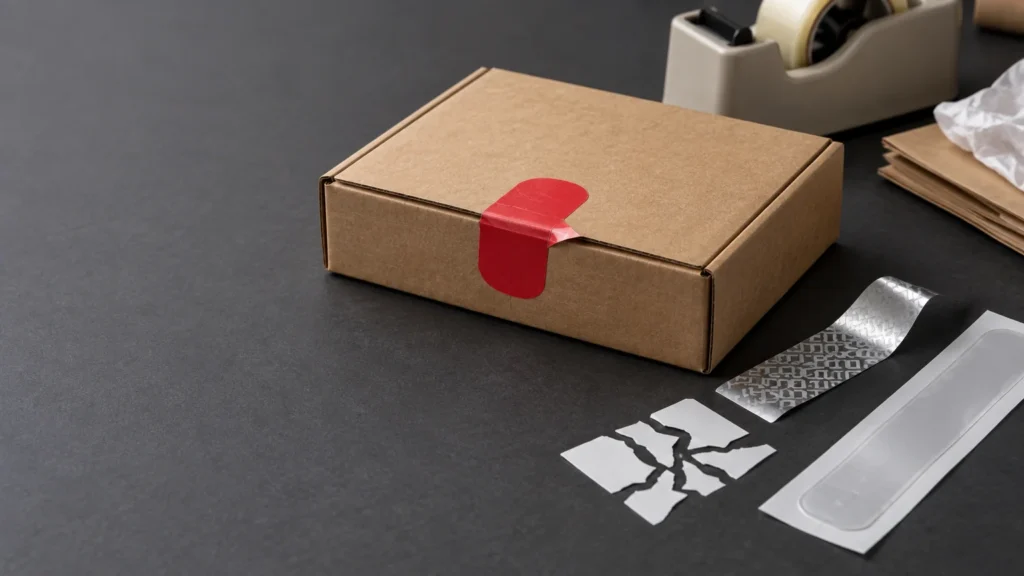
Choose tamper evident stickers for packaging according to the evidence you need after someone opens or removes the seal. Use a void-transfer label when you want a message or pattern left behind, a destructible label when the seal should fragment during removal, and a purpose-made seam seal when a visibly broken bridge across an opening is enough. Test the complete seal-and-package combination before ordering at scale; adhesive performance can change substantially across corrugate, coated cartons, glass and different plastics.
The right seal starts with the opening, not the artwork. Identify where the package separates, place the sticker so opening requires breaking or removing it, and then choose a construction that produces unmistakable evidence on that particular surface. A standard branded sticker can provide a closure cue, but it is not automatically tamper-evident if it can be peeled away and reapplied cleanly.
What tamper-evident stickers do—and do not promise
Tamper-evident packaging is designed to make an opening or attempted removal visible. It does not make a package impossible to open. That distinction matters because “tamper-proof” suggests a level of prevention that an adhesive label cannot realistically provide. Avery Dennison makes the same distinction in its technical description of voidable polyester labels: these materials reveal words or patterns after removal, but the broader goal is evidence of interference rather than an unopenable package.
A useful seal answers a simple question at a glance: does this package appear to have remained closed since the seal was applied? Evidence may take the form of a broken label, fragmented film, transferred VOID message, disturbed printing or adhesive residue. The best form depends on what customers and staff must be able to recognize quickly.
Ordinary paper or vinyl stickers may still work as decorative carton seals, especially when the purpose is branding and neat closure. You can order custom printed stickers for that general packaging role, but confirm that a vendor offers a purpose-made security construction before treating the result as tamper-evident.
Compare void-transfer, destructible and seam-seal formats
| Format | Evidence after opening | Best starting point | Main tradeoff |
|---|---|---|---|
| Void-transfer label | A word, pattern or layer remains on the surface, and the removed label is visibly altered | Smooth boxes, rigid containers, electronics or higher-value products where clear removal evidence matters | Transfer performance is sensitive to the package surface and adhesive match |
| Destructible or frangible label | The label tears, flakes or breaks into pieces when removal is attempted | Small rigid containers, closures and applications where intact removal should be difficult | Application and cleanup can be slower; very rough surfaces may reduce contact |
| Purpose-made seam seal | The bridge across a flap, lid or cap breaks or becomes visibly disturbed | Cartons, mailers, folding boxes, jars and bottles with a defined opening | Its effectiveness depends heavily on placement and resistance to clean peeling |
| Standard branded sticker | The sticker may tear, crease or lift, depending on its material and adhesive | Branding, presentation and basic closure indication | It may peel away and be reapplied without reliable evidence |
Void-transfer labels
A void label separates internally when lifted. Depending on its construction, it can leave a repeating word, geometric pattern or other indication on the package while revealing a corresponding negative image in the removed label. EUIPO describes void labels as producing visible evidence on the protected item and notes that a warning can remain visible if someone attempts to reapply the label.
This format is useful when a broken edge would be too subtle or when employees need a highly legible removal signal. It usually performs best on a surface that gives the adhesive broad, consistent contact. Deep corrugate texture, dusty recycled board and low-surface-energy plastics require especially careful testing.
Destructible labels
A destructible label uses a frangible facestock that breaks before it can be removed intact. Rather than leaving a printed transfer message, it provides evidence through fragmentation. This can be a good fit for a jar lid, bottle closure or small box tab where the customer can easily see that the original label is no longer whole.
The material must be fragile enough to break during removal but strong enough to survive application, packing and shipping. Thin extensions and sharp inside corners can tear too early, while an oversized seal may wrinkle around curves. Rounded corners and a shape that follows the opening geometry usually make handling easier.
Seam-seal stickers
A seam seal bridges two package components, such as a carton flap and sidewall. It may be made from paper, film or a security construction. What makes it useful is that the package cannot open normally without breaking, cutting or visibly disturbing the bridge.
Do not assume every branded carton seal provides strong evidence. The FDA has specifically identified adhesive tape seals that can be removed and reapplied without visible evidence as a concern in the context of covered OTC drug packaging. That principle is useful even for unregulated products: if clean removal and reapplication are possible, the seal is primarily decorative.
Choose the format by package opening
| Package | Practical seal position | Good format to test first |
|---|---|---|
| Mailer box | Across the front tuck flap and box wall | Destructible or void-transfer seal |
| Folding carton | Across the opening flap, avoiding a loose or heavily scored area | Destructible seam seal |
| Shipping carton | Across the actual closure seam, not only on an unrelated panel | Security tape or a large purpose-made seam seal |
| Bottle with screw cap | From the cap or neck band onto the bottle shoulder, if geometry permits full contact | Conformable destructible seal or a designed closure band |
| Jar | Across the lid edge and onto the container body | Flexible destructible bridge seal |
| Pouch | Across a reclosable opening only if the sticker can bond consistently to the film | Purpose-made film seal; an integrated pouch feature may be better |
| Rigid case or asset | Across the door, access panel or two-part housing | Void-transfer label |
For a box flap, put the seal where normal opening must affect it. A label placed nearby may look official without controlling the opening. Avoid bridging a large recess where the center of the sticker never contacts the package.
Bottle caps and jar lids introduce curves, small bonding areas and torque. A stiff label can lift at the edges before the product reaches the customer. A narrow, conformable strip may fit the geometry better, but it should not be so narrow that someone can cut and disguise the opening easily.
Folding cartons often have varnish, coatings, paper dust, score lines and spring tension around the flap. Place the seal on stable panels on both sides of the opening. If the design must cross a score, test whether bending creates premature cracking or lifting.
Match the adhesive and material to the surface
The same label can behave very differently on coated paperboard and raw corrugate. Surface texture reduces the effective contact area, while coatings, mold-release agents, condensation, oils and dust can interfere with adhesion. Package material is therefore part of the security construction, not merely the background beneath it.
- Corrugate: Test across both the liner texture and any printed or coated areas. Fibers may pull away with aggressive adhesives, while dusty board may produce weak bonding.
- Coated folding cartons: Check whether varnish, lamination or soft-touch coatings allow clean peeling. Test directly on the final print finish.
- Glass and metal: These offer smooth contact but must be clean and dry. Oils or condensation can create localized lifting.
- PET, HDPE and other plastics: Identify the exact package resin and any surface treatment. Labels that hold well on one plastic may lift from another.
- Textured or curved containers: Favor a conformable construction and avoid placing edges where the package shape continually tries to spring them upward.
- Cold or wet packaging: Consider both application conditions and service conditions. A label applied to a warm, dry package and chilled later faces a different job from one applied inside a cold room. For frozen products, use the separate guide to freezer-safe packaging labels.
Also decide whether residue is desirable. A void transfer or conspicuous residue can make interference obvious, but it may be unsuitable for reusable containers. A no-residue feature can keep the package cleaner, although the removed label itself must still provide clear evidence and resist convincing reapplication.
Design seals to make disturbance easy to recognize
A security label still needs straightforward graphic design. Use enough contrast for the seal to be noticed, especially where it crosses a busy printed carton. Add direct wording such as “Do not use if seal is broken” only when that instruction accurately reflects the package system and product requirements.
Keep important words and serial numbers away from the exact break line unless splitting them is intentional. Tiny lettering, thin borders and low-contrast printing can make a disturbed seal harder to interpret. If the material reveals a VOID pattern, confirm that the pattern contrasts with the actual package color.
Numbering can help a warehouse or retailer reconcile seals with batches, but a number does not make a sticker tamper-evident. Similarly, QR codes can connect customers to product information, while RFID and NFC can support identification, tracking or authentication workflows. EUIPO treats serialized identifiers, QR codes, RFID and NFC as technologies serving these additional functions rather than as substitutes for a visible tamper indication.
Regulated products require a complete packaging decision
For covered U.S. over-the-counter human drug products, federal rules require tamper-evident packaging with an indicator or barrier to entry that, if breached or missing, can reasonably be expected to provide visible evidence to consumers. The feature must also be distinctive by design or another identifying characteristic, and the labeling must identify that feature.
A generic security sticker should not be described as “FDA-compliant” on its own. Compliance depends on the complete package, how entry occurs, what evidence remains, the feature’s distinctiveness and the statement presented to consumers. The FDA’s tamper-resistant packaging compliance policy guide discusses examples such as container-mouth inner seals, pouches and breakable caps, showing why the closure system must be evaluated as a whole.
Tamper evidence is also different from child resistance. One tells the customer that a package may have been opened; the other is intended to make access more difficult for children. FDA consumer guidance discusses tamper-evident features separately from child-safety closures. A product may need one, both or additional controls depending on its category and market.
Test the finished package before a full production run
A useful trial should reproduce the real package, printing, filling environment and distribution conditions as closely as practical. Applying a sample to a clean laboratory panel does not reveal what will happen on a dusty carton, chilled bottle or flexible pouch.
- Apply samples to the final package material, including its coating, ink or laminate.
- Place each seal across the real opening and check for wrinkles, unsupported spans and edge tension.
- Allow the label to remain in place for the supplier’s specified dwell period before evaluating removal.
- Attempt slow peeling, fast peeling, lifting with a thin edge and reapplication.
- Confirm that the resulting evidence is obvious to someone who did not apply the original seal.
- Pack and ship test units through realistic compression, vibration, temperature and moisture conditions.
- Check whether intact seals survive normal distribution without becoming so easy to remove that interference is hidden.
- Document the approved material, adhesive, dimensions, placement and application conditions for production staff.
The central buying decision is not simply paper versus film. Decide what visible evidence you need, match that mechanism to the package surface, and force the seal to cross the actual route of entry. For most cartons and jars, start by testing a destructible bridge seal. Move to a void-transfer construction when a persistent message on the package would make removal easier to recognize. Use an ordinary branded sticker only when presentation and closure indication—not dependable tamper evidence—are the real goals.
References
- Tamper Evident Polyesters Technical Marketing Bulletin
- Void Labels | Anti-Counterfeiting and Anti-Piracy Technology Guide
- CPG Sec. 450.500 Tamper-Resistant Packaging Requirements for Certain Over-the-Counter Human Drug Products | FDA
- Technology Map | Anti-Counterfeiting and Anti-Piracy Technology Guide
- 21 CFR § 211.132 – Tamper-evident packaging requirements for over-the-counter (OTC) human drug products. | Electronic Code of Federal Regulations (e-CFR) | US Law | LII / Legal Information Institute
- Over-the-Counter Medicines: What's Right for You? | FDA